The Strategy Marketplace: Share What Works
How Alphactor's Strategy Marketplace lets you browse, adopt, and rate community-published trading strategies with full performance transparency.
 Marcus Chen4 min read
A New Way to Find Strategies
Building a trading strategy from scratch takes time. You test indicators, tune parameters, run backtests, check credibility, and iterate. That process is worth doing for strategies you want to deeply understand. But what if someone else already did the work on a ticker you follow, validated the results, and is willing to share?
Alphactor's Strategy Marketplace is where that exchange happens. Users publish strategies they have built and tested. Other users browse, evaluate the performance data, adopt the ones that fit their trading style, and leave ratings based on their experience.
How the Marketplace Works
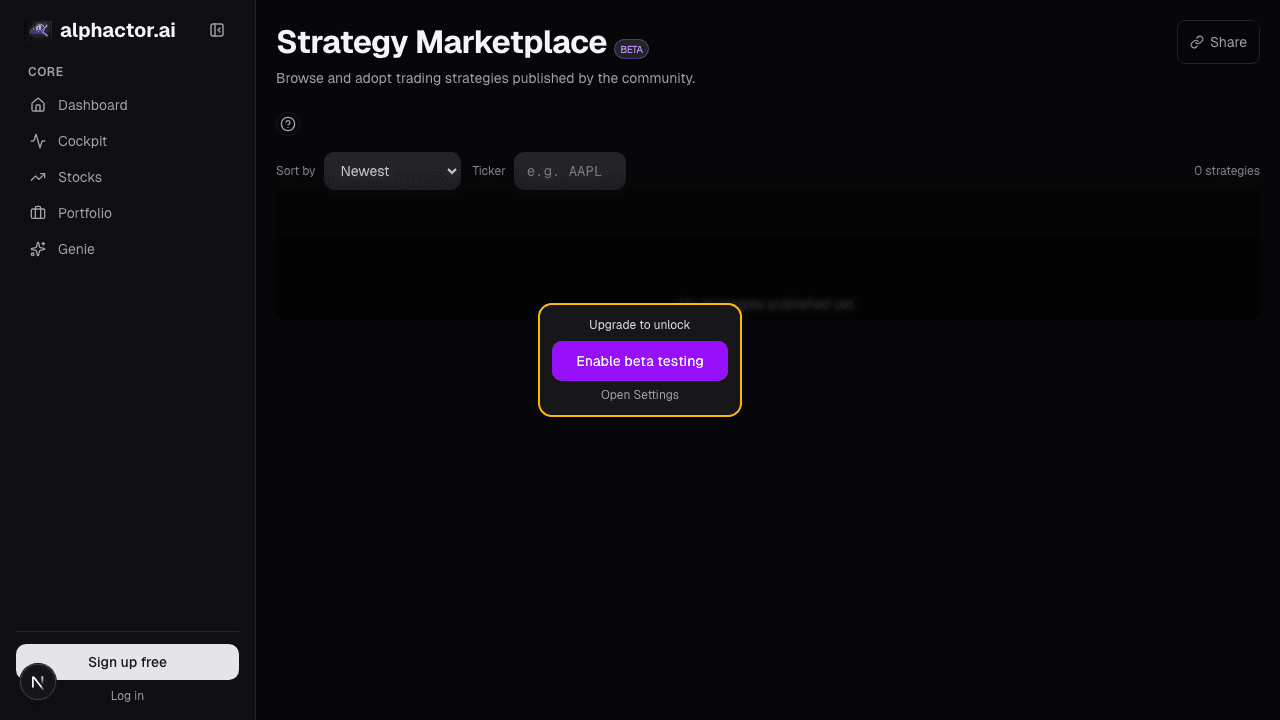
The strategy marketplace page shows a grid of published strategies. Each card displays the ticker, the strategy name, who created it, and four key performance metrics: Sharpe Ratio, Total Return, Win Rate, and Maximum Drawdown. You also see an adoption count and a star rating from users who have tried it.
You can sort strategies by Sharpe Ratio, Total Return, Most Adopted, Highest Rated, or Newest. You can filter by ticker if you are looking for strategies on a specific stock. This is not a firehose of unvalidated ideas. Every strategy in the Marketplace has backtest data attached, so you can evaluate it before committing.
When you click into a strategy, you see the full detail view: all performance metrics, the creator's profile, the adoption count, every user rating and review, and the strategy's current status. If you want to use it, click Adopt. The strategy gets copied to your own strategy list for that ticker, where you can run it, modify it, or just track its signals.
Why Adoption Beats Copying
The Marketplace is not a forum where someone posts "buy when RSI drops below 30" and you manually recreate it. Adoption copies the full strategy configuration, including indicator settings, entry and exit conditions, and parameter values, directly into your account. You get the exact setup the creator tested, not an approximation.
Once adopted, the strategy is yours. You can run it as-is, or modify it freely. The original creator's version stays unchanged in the Marketplace.
Evaluating Before You Adopt
Not every published strategy deserves your attention. Here is a practical framework for evaluating Marketplace strategies.
Check the Sharpe Ratio first. A Sharpe below 1.0 means the returns were not particularly impressive relative to the volatility. Above 1.5 is strong. Above 2.0 is exceptional and worth investigating for overfitting.
Look at Win Rate and Max Drawdown together. A 70% win rate means nothing if the losses are large enough to produce a 40% drawdown. Conversely, a 45% win rate with controlled drawdowns suggests the strategy cuts losers quickly and lets winners run.
Read the ratings and reviews. A strategy with 15 adoptions and a 4.5-star rating has social proof. One with 2 adoptions and no reviews is unproven territory. Reviews often contain practical details that the metrics alone do not reveal, like how the strategy performs in specific market conditions.
Consider the ticker. A strategy built and tested on AAPL may not transfer to a small-cap biotech. If you are adopting a strategy for a ticker you follow, the context is already familiar. Adopting across very different stock profiles requires more caution.
Publishing Your Own Strategies
If you have built a strategy on Alphactor and it has strong backtest results, you can publish it to the Marketplace from your strategy page. Publishing makes the strategy visible to all users, along with its performance metrics.
Publishing is a one-way share. Other users can see the strategy's performance and adopt a copy, but they cannot modify your original. You retain full control.
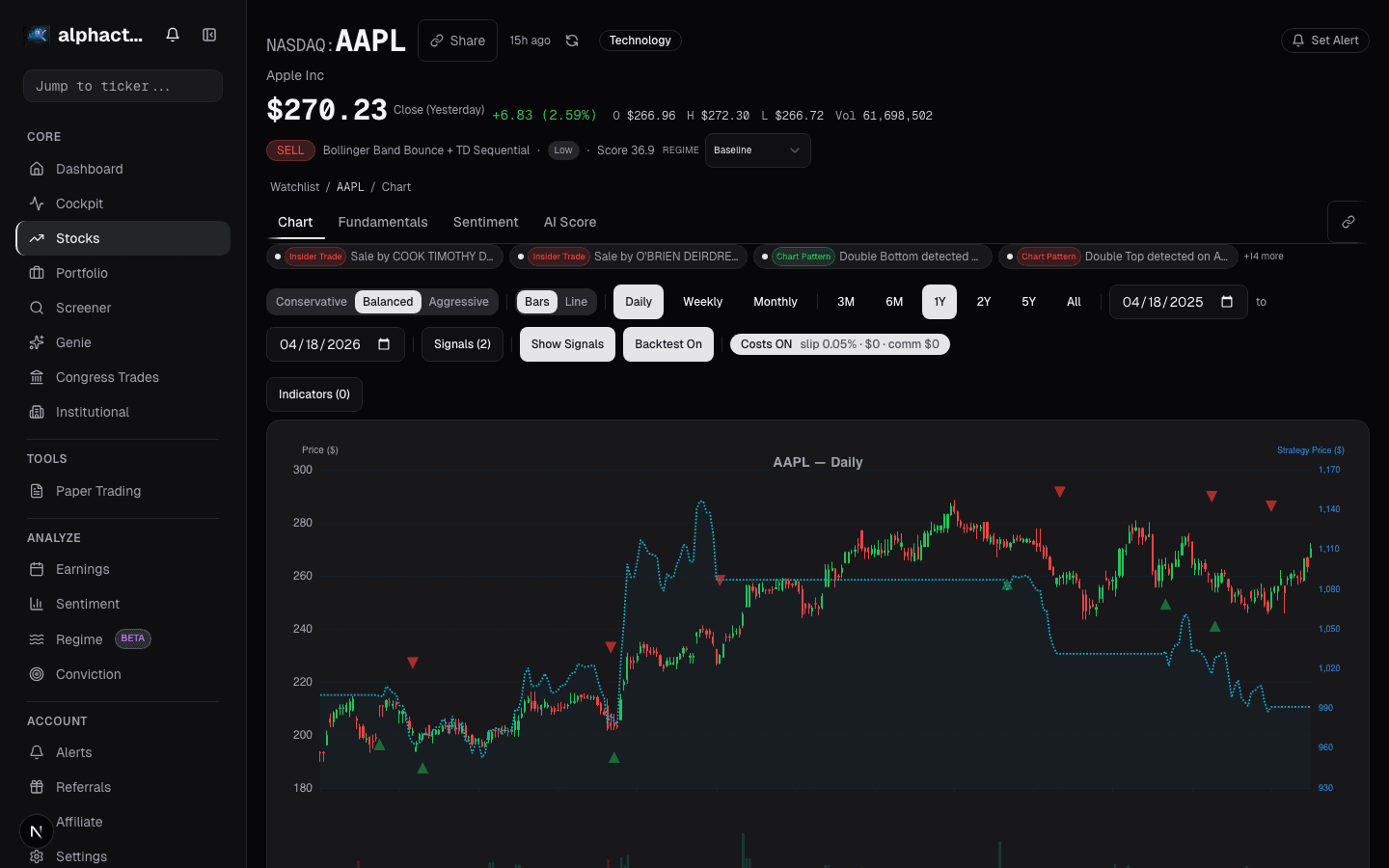
There is a reputational incentive built in. Strategies you publish contribute to your public profile. High adoption counts and strong ratings build your track record on the platform. If your strategies consistently perform well, the leaderboard and your profile page reflect that.
A Practical Scenario
Say you recently added MSFT to your watchlist and want to explore momentum strategies for it. Instead of building one from scratch, you open the Marketplace, filter by MSFT, and sort by Sharpe Ratio. Three strategies appear. The top one has a 1.8 Sharpe, 22% return, 58% win rate, and 12% max drawdown. It has been adopted 28 times with a 4.2-star rating.
You click in, read the reviews, and see that users report it performs well in trending markets but gives back gains during consolidation. That aligns with your expectation for a momentum approach. You adopt it, and it appears in your MSFT strategy list. You can now run it against current market data, track its signals, or tweak parameters to match your risk tolerance.
The entire process took two minutes. Building and validating a comparable strategy from scratch would have taken hours.
What the Marketplace Is Not
The Marketplace is not financial advice. Past performance metrics, no matter how impressive, do not guarantee future results. A strategy that returned 30% over three years might return nothing over the next three. The credibility pipeline helps separate signal from noise, but no tool eliminates uncertainty.
What the Marketplace does is dramatically reduce the cold-start problem. Instead of starting every analysis from zero, you start from a community-validated foundation and make it your own.
See it in the app
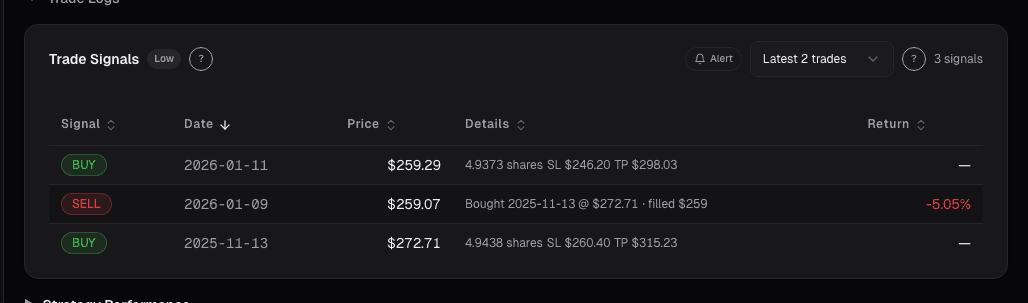
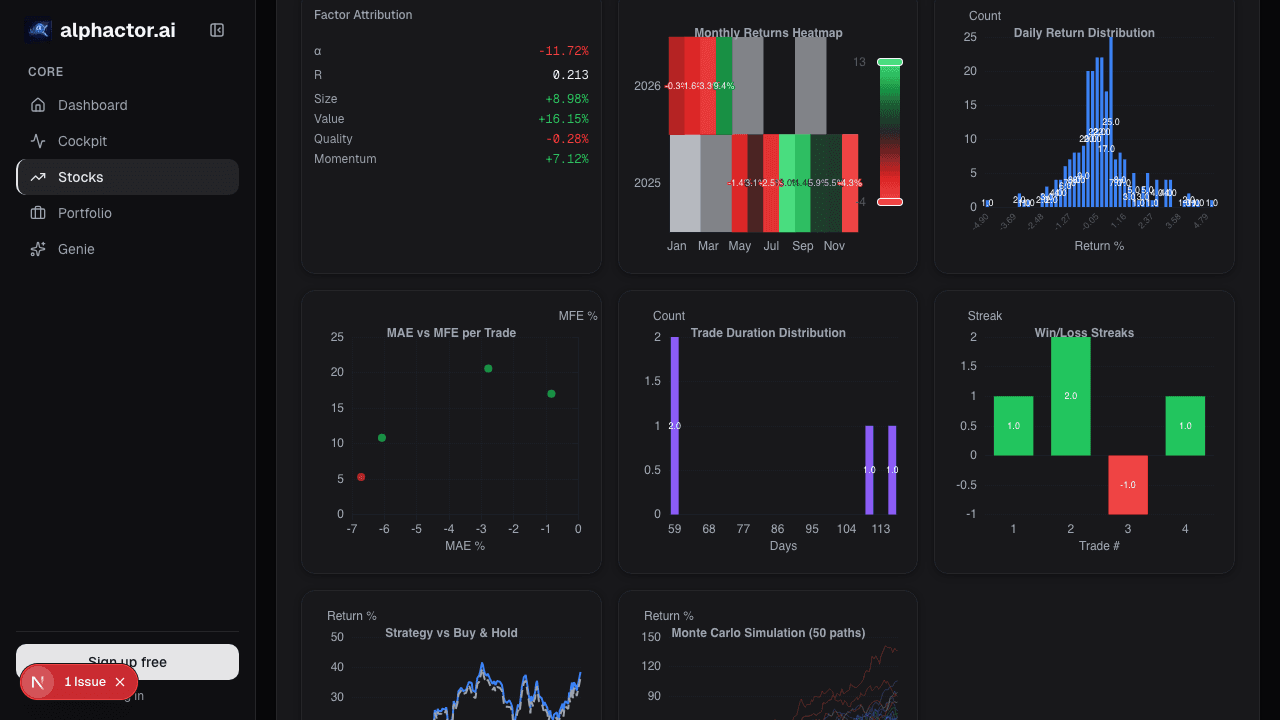
Live dashboard views that match this post. Each tile deep-links to the exact card.
Stocks mentioned
Related reading
The AI Copilot: Ask Your Portfolio a Question
How Alphactor's AI Copilot turns natural language questions into data-driven portfolio insights, grounded in your actual holdings and market data.
Cockpit Cards: Quick-Glance Intelligence per Stock
How cockpit cards surface the signals, events, and changes that matter most across your watchlist and portfolio without information overload.
Free vs Pro: Which Plan Fits Your Trading Style?
A practical comparison of Alphactor's Free, Pro, and Premium plans to help you pick the right tier for your trading and analysis workflow.
Alphactor on Mobile: Full Analysis Power in Your Pocket
How Alphactor's mobile experience delivers portfolio monitoring, strategy signals, alerts, and stock analysis from your phone.
Regime-Aware Strategy Selection
Markets cycle through trends, ranges, and shocks. Learn how regime detection drives which strategy runs, and why a mixture of experts beats a single static…
Ready to try alphactor.ai?
Validate your trading strategies with statistical credibility testing. Start free.
Get Started Free