House Trades: Per-Ticker Flow From the Lower Chamber
Representatives trade under the STOCK Act like senators, but House flow has a different character, shorter terms, narrower districts, and more industry…
 Marcus Chen7 min read
A reader once asked me why I bothered to read House disclosures separately from Senate disclosures. "It's all Congress," he said. "Why not just combine them and get a bigger sample size?" Because the two chambers have different committee jurisdictions, different election cycles, and different member incentives, and the flow patterns that come out of them have different predictive properties. Treating them as a single "Congress trades" blob smears information that a split view makes visible.
This post is about what the House Trades card surfaces, why House flow behaves differently from Senate flow, and the two patterns in House disclosures that I've found durable enough to act on.
TL;DR
- House members serve 2-year terms and represent ~770,000-person districts. Shorter horizons and more industry concentration than senators.
- Bipartisan committee clusters are the highest-signal House pattern. Same committee, both parties, same direction, that's not politics.
- Partisan flow from Energy & Commerce or Financial Services leads legislative markups. 1–2 quarter lead time is realistic.
- Freshman representatives produce noisy flow. They haven't accumulated committee context yet. Weight their trades lower.
- House flow supplements Senate flow; it doesn't replace it. Use both chambers, read them separately.
Why House flow belongs in its own view
The House and Senate have different legislative character. House members serve 2-year terms, represent geographic districts of roughly 770,000 people, and sit on committees whose jurisdictions are often tightly scoped to specific industries (Energy and Commerce on telecom/tech/health, Financial Services on banks and capital markets, Ways and Means on tax policy). The 2-year cycle makes their incentives more short-term than senators'. The narrower district makes their committee focus more specialized, a House member from a district with three auto plants will often be on committees related to manufacturing and trade, and their industry exposure is more readable than a senator covering an entire state's mixed economy.
That difference in character plays out in the disclosures. House flow tends to be more industry-clustered than Senate flow. When you see four Energy and Commerce Democrats all trim their cable positions in the same month, that's a committee-specific signal, not a political one. Senate flow, by contrast, is more broadly-based, senators are generalists who sit on mixed committees, so their trades span sectors more diffusely.
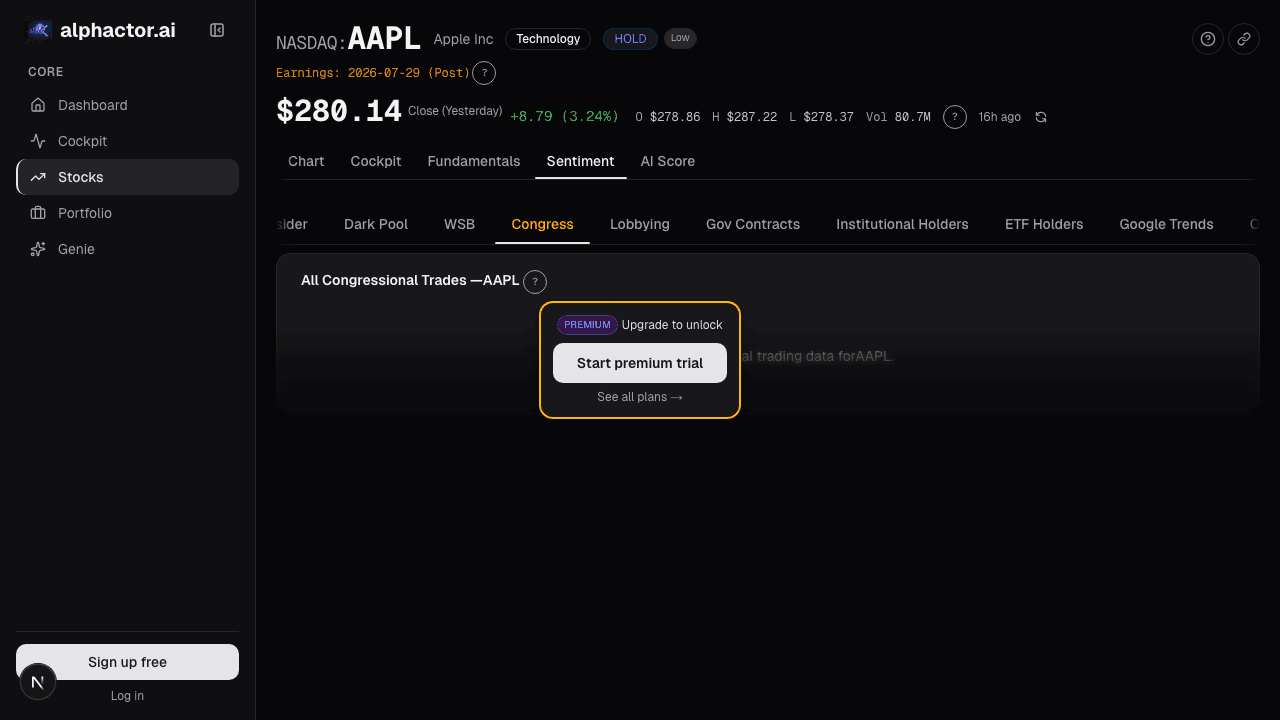
What the House Trades card shows
The House Trades card lists every STOCK Act disclosure for the viewed ticker:
- Representative name, party, state, and district number
- Committee assignments with a jurisdictional flag if the ticker's primary business falls under one
- Trade date, filing date, and disclosure lag (capped at 45 days by statute)
- Direction: buy, sell, option write, or option buy, with options flagged separately because their information content differs
- Size range: the statutory ranges ($1,001–$15,000, $15,001–$50,000, etc.)
- Freshman indicator: first-term representative flag
A 12-month roll-up strip shows net buys vs. sells segmented by party, by committee, and by jurisdictional relevance. A sparkline below the roll-up shows net flow over time so inflection points are visually obvious.
Two patterns that hold up
Bipartisan committee cluster flow. When multiple members of the *same committee* from *both parties* trade the same name in the same direction within a two-quarter window, the signal content is high. The reason is that bipartisan agreement on a position crosses the partisan noise, it's not about electoral positioning or fundraising-donor alignment, it's about something the committee is collectively seeing. Example: in early 2024 I watched five Financial Services Committee members (3 Democrat, 2 Republican) net-buy shares of a mid-cap regional bank over eight weeks. That's the kind of pattern that would deserve a second look at the fundamentals, not because the representatives know something secret, but because they're the people briefed on the regulatory pipeline affecting that bank's business.
Partisan flow from jurisdictional committees as a leading indicator of legislation. When members of Energy and Commerce or Financial Services start trading heavily in a direction on names under their jurisdiction, there's often a markup or bill draft moving through the committee in the following quarter or two. The members aren't necessarily trading on non-public information, much of the legislative calendar is public, but they have advance read on *which* provisions are likely to survive committee and which are cosmetic. The flow is a lagging indicator of committee-level attention and a leading indicator of floor action.
What doesn't hold up
- Total "Congress bought this" aggregate counts without chamber or committee split. Noise. The committee context is where the signal lives.
- Freshman member trades in isolation. First-term House members haven't accumulated committee context yet. Their flow is often retail-style, driven by personal investment interest rather than legislative visibility.
- Single-representative directional bets. One House member buying one stock is noise; you need a cluster.
- Small-size options disclosures. Representatives' options trades are often written by advisers, and the member's personal decision weight is low.
- Flow from committees unrelated to the ticker. A Transportation Committee member buying a biotech is not a committee signal; it's a personal trade with no edge.
Example: a tax-bill markup in 2025
In early 2025 the Ways and Means Committee was moving a tax bill that included changes to the tax treatment of certain real-estate depreciation schedules. Over the four weeks leading up to markup, I saw six Ways and Means members (from both parties) make net sales in three publicly-traded REITs that were heavily exposed to the affected depreciation rules. The flow showed up in the House Trades card as a partisan-balanced sell cluster on committee-jurisdictional names.
The markup ultimately kept most of the depreciation changes. The three REITs dropped an average of 9% over the subsequent month. I don't claim the representatives knew the markup outcome in advance; I do claim they had better-than-public visibility into what was likely, and their flow was informative before the markup. The value of the flow wasn't the trade idea, shorting REITs on a tax bill is an obvious thesis, but the timing confirmation that the bill was moving in a specific direction.
Common mistakes
- Combining House and Senate flow into one "Congress" count. Two chambers, two sets of committee jurisdictions, two different flow characters. Don't blend them.
- Ignoring district context. A representative from a district heavily exposed to a specific industry has different incentives than one from a diversified district. District context colors the trade.
- Treating all committees as equal. Energy and Commerce, Financial Services, and Ways and Means are the high-signal committees because their jurisdictions are industry-specific and the bills moving through them move stocks. House Administration and House Ethics, less so.
- Not filtering freshman members. The first-term House member flow is noisy. It'll get less noisy in years 3–4 once committee context has accumulated.
- Acting on a single disclosure. Clusters are the whole signal. One trade is never enough.
Where it fits
Pair with Senate Trades for the upper-chamber view, Congress Summary for the unified per-ticker roll-up across both chambers, and Congress Diff for quarter-over-quarter aggregate change. Lobbying adds the spend-side policy signal, lobbying expenditures often precede the legislative events the House flow is reacting to.
FAQ
Is House flow as predictive as Senate flow?
The academic consensus pre-STOCK-Act was that Senate portfolios slightly outperformed House portfolios, but the effect has narrowed since disclosure became more timely. In my experience, Senate aggregate flow is slightly cleaner but House committee-level flow is richer when you split by committee. They serve different purposes.
How fast is the House disclosure feed?
Disclosures hit the House Clerk feed typically within 1–3 days of filing. Our ingestion polls every few hours. The filing lag (which can be up to 45 days) dominates the total latency, not our pipeline.
What's the legal basis for House members trading individual stocks?
The STOCK Act (2012) allows it with mandatory disclosure; the ethical debate about whether it *should* be allowed continues in Congress but hasn't changed the law as of this writing.
Do family-member trades get disclosed too?
Yes, spouse and dependent trades are covered by the STOCK Act under the same timing rules and are tagged on the card. Information content is typically lower than member-direct trades but not zero.
Can I set alerts for specific representatives or committees?
Yes, the Trade Alerts surface supports rules filtered by chamber, party, committee, and size range. I use a rule that fires on any Energy and Commerce or Financial Services member buying or selling a name I hold or watch.
Related reading
- Congress Senate Trades
- Congress Live Activity Feed
- Congress Diff Quarterly Snapshot
- Congress Trades per Ticker
Open the House Trades card → /app/stocks/AAPL/sentiment
See it in the app
Live dashboard views that match this post. Each tile deep-links to the exact card.
Stocks mentioned
Related reading
Congress Diff: What Legislators Bought and Sold This Quarter
One senator's $50k buy isn't a thesis. Thirty members of Congress netting positive in Big Tech while netting negative in regional banks is, because the…
Congress Live Activity: Legislator Trades in Near-Real-Time
Congress Live Activity aggregates STOCK Act filings with jurisdictional flags and cluster alerts, turning scattered PDFs into a scannable daily signal.
Senate Trades: The Upper Chamber's Equity Flow
Senate committee-overlap signal is stronger than House trades. One-sided flow from Armed Services or Banking members is highest-information political signals.
Congressional Trades on a Single Stock
The 'Congress outperforms the market' story hides where the actual signal is. It's not aggregate Congressional portfolios, it's a single committee chair's…
How to Track Congressional Stock Trades (And Why You Should)
How to use Alphactor's congressional trade tracker to monitor stock transactions disclosed by US lawmakers and incorporate them into your research.
Ready to try alphactor.ai?
Validate your trading strategies with statistical credibility testing. Start free.
Get Started Free