Congressional Trades on a Single Stock
The 'Congress outperforms the market' story hides where the actual signal is. It's not aggregate Congressional portfolios, it's a single committee chair's…
 Marcus Chen6 min read
The "Congress beats the market" meme has been circulating on financial Twitter for years. Every time a senator files a timely disclosure, a wave of screenshots goes up with captions like "they must know something" and "just copy her trades." The problem is that the aggregate Congressional portfolio beating the market is barely true (the effect has largely decayed post-STOCK Act), and even where it is true it's driven by a small subset of specific trades, committee-relevant trades by members in the closed-briefing loop on the issuer. The average senator trading based on their index-fund advisor produces zero information. The single senator on Armed Services buying a defense prime before a budget authorization has meaningful informational content. The aggregate blurs the two.
This post is about the per-ticker Congress Summary card, why the committee-match filter is doing most of the work, and what the academic literature actually says about Congressional trading as a signal.
TL;DR
- Aggregate Congressional flow is barely a signal. The academic advantage has decayed.
- Committee-relevant trades are where the signal concentrates. Filter hard.
- Late filers deserve extra skepticism. Disclosure timing correlates with trade consequentiality.
- Converging disclosure regimes > any single regime. Corporate insider + 13F + STOCK Act pointing the same direction is rare and informative.
- Per-ticker is the tradeable view. Dashboard aggregate is the context layer.
Why per-ticker matters more than aggregate
The "Congress beats the market" story travels well because it's emotionally resonant, elected officials trading on information ordinary investors don't have fits a narrative everyone already believes. The empirical story is more nuanced. Ziobrowski et al. (2004) documented a Senate portfolio excess return of ~85 bps per month pre-STOCK-Act; post-Act follow-ups (Eggers and Hainmueller 2013, Chen et al. 2017) find the effect dramatically reduced, with most of the remaining alpha concentrated in committee-relevant trades.
That distinction, aggregate vs. committee-relevant, is the whole game for usefulness. A senator buying a random stock they picked up at a party says nothing. A senator on Armed Services buying a defense prime the month before a budget authorization hearing says something. The per-ticker view lets you filter to the second case; the aggregate blurs both into an average that's barely distinguishable from noise.
What the Congress Summary shows
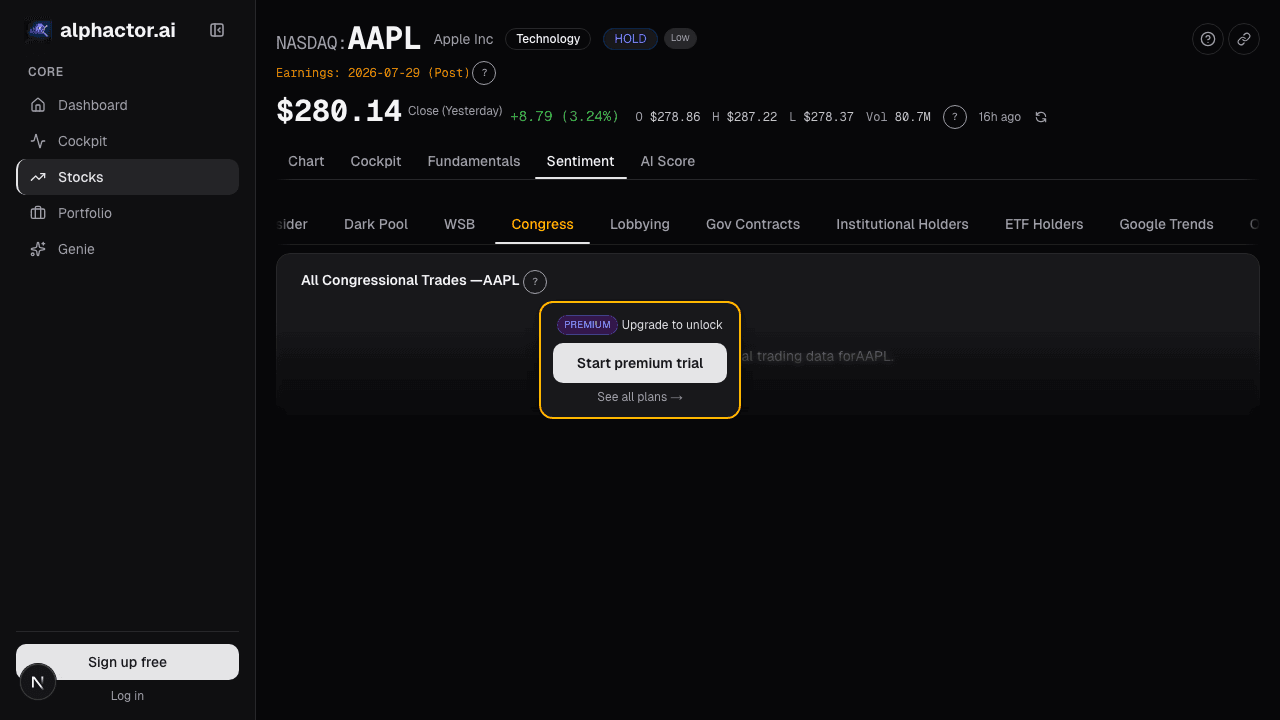
The Congress Summary card aggregates the trailing 12 months of disclosed trades on the viewed ticker:
- Net buy/sell dollars broken down by:
- Chamber (Senate vs. House)
- Party (Democrat / Republican / Independent)
- Relevant committee assignments, auto-flagged when the ticker's primary business falls under a committee the member sits on
- 5 most recent reportable trades: member, party/state, chamber, trade date, filing date, disclosure lag, size range, and a link to the underlying eFD or House Clerk filing
- Committee-match flag per transaction, whether the trading member sits on a committee with jurisdictional overlap on the issuer
- Disclosure-lag buckets: under 10 days, 10–30 days, 30–45 days, flagged at the 45-day statutory cap
A sparkline below the roll-up shows net flow over time so inflection points (a sudden uptick in cluster flow, a flip from net buys to net sells) are visually obvious.
Reading the signal
The academically verified pattern is narrow and specific: trades by members on committees with jurisdictional overlap to the issuer outperform; trades by members not on relevant committees don't. That's the filter that does 90% of the work. For a defense contractor, the relevant committees are Armed Services (both chambers), Intelligence (both chambers), and Appropriations defense subcommittees. For a bank, Financial Services (House) and Banking (Senate). For a pharmaceutical, HELP (Senate) and Energy and Commerce (House). The card's committee-match flag pre-filters for this; it's a heuristic based on GICS sector and committee jurisdiction, not perfect on edge cases (conglomerates, holding companies), but good enough to be usable.
The second filter that matters: disclosure-lag. The STOCK Act allows up to 45 days between trade and disclosure. Members who file within 10 days have behaviorally different trades than members who file at the 45-day cap. Early filers tend to have more routine trades; late filers correlate (empirically, mechanism is unclear) with more consequential ones. I weight late filings more heavily in my reading and treat lag > 40 days as a yellow flag on that specific disclosure.
What doesn't work
- Single-trade interpretations. One member buying one stock is noise. Clusters (3+ members on a relevant committee in the same window) is where the signal lives.
- Aggregate "Congress bought / sold" counts. Ignores the committee filter. Noise.
- Party-homogeneous flow without committee overlap. Four Republican senators buying a stock with no committee relevance is usually correlated retail behavior, not edge.
- Spouse or dependent trades treated at full weight. They carry less signal on average, the member's direct decision weight is typically lower. Still usable but discounted.
Example: a converging-regimes setup
In early 2024 I was looking at a defense prime contractor. The per-ticker Congress Summary card showed net buys concentrated in Armed Services and Intelligence members over the trailing 6 months, seven members, bipartisan, no contemporaneous sells. The Insider MSPR card showed corporate insiders (CEO and two VPs) buying in Q4 2023, small dollar amounts, but direction was long. Institutional Holders showed three large 13F holders adding in Q4 13F filings.
Three different disclosure regimes, corporate insider, institutional 13F, and STOCK Act, were pointing in the same direction within a 6-month window. That's rare enough to be non-coincidental. The setup wasn't predictive per se; I still did fundamental work before sizing in. But the converging-regime view was a strong prompt that the "information set" on this name was tilted bullish across independent reporting channels. The position worked over the subsequent 8 months.
Common mistakes
- Confusing disclosure with insider trading. STOCK Act disclosures are legal, the point of the law is public transparency. "They must be insider trading" misses that the disclosures are precisely what the law requires.
- Overweighting a single senator. Every aggregation framework benefits from multi-member clustering. One disclosure doesn't make a signal.
- Ignoring the committee filter. Without it, you're reading noise. It's the single highest-impact filter on the data.
- Acting on disclosures the day they file. The trade itself happened up to 45 days earlier. The market has often already absorbed the news the member was positioning for.
- Forgetting these disclosures are public. Anyone who wants the data has it. Your edge is in aggregation and interpretation, not access.
Where it fits
Pair the per-ticker card with the full Congress activity dashboard for cross-name pattern recognition, a committee chair who just bought your stock *and* 3 peer tickers on the same day is running a sector thesis. On-ticker, confirm with Insider MSPR and Institutional Holders, three converging disclosure regimes is a cleaner setup than any single one. For chamber-specific deep reads, use the House Trades and Senate Trades cards.
FAQ
Is Congressional trading on disclosures profitable as a strategy?
Modestly, and only with aggressive committee-match filtering. Aggregate "copy Congress" strategies (no filter) have produced roughly market-like returns post-STOCK-Act. Committee-filtered strategies have a small positive edge in most academic replications.
How timely is the data?
Our ingestion polls the Senate eFD and House Clerk databases every few hours. Latency is dominated by the statutory filing delay (up to 45 days), not by the pipeline.
What about trades disclosed after the 45-day cap?
Rare but they happen. Our ingestion captures them with the actual filing timestamp; the card flags them as late-filed. These often correlate with consequential trades.
Can I set alerts?
Yes, Trade Alerts supports rules filtered by ticker + committee + chamber + size range. I use a rule that fires on any Armed Services member trading a name in my portfolio or watchlist.
What about international equivalents (UK, EU members)?
Some jurisdictions have similar disclosure regimes; our coverage today is U.S. only. If there's demand for UK / EU expansion we'd consider it.
Related reading
Open the Congress Summary card → /app/stocks/AAPL/sentiment
See it in the app
Live dashboard views that match this post. Each tile deep-links to the exact card.
Stocks mentioned
Related reading
Congress Diff: What Legislators Bought and Sold This Quarter
One senator's $50k buy isn't a thesis. Thirty members of Congress netting positive in Big Tech while netting negative in regional banks is, because the…
House Trades: Per-Ticker Flow From the Lower Chamber
Representatives trade under the STOCK Act like senators, but House flow has a different character, shorter terms, narrower districts, and more industry…
Congress Live Activity: Legislator Trades in Near-Real-Time
Congress Live Activity aggregates STOCK Act filings with jurisdictional flags and cluster alerts, turning scattered PDFs into a scannable daily signal.
Senate Trades: The Upper Chamber's Equity Flow
Senate committee-overlap signal is stronger than House trades. One-sided flow from Armed Services or Banking members is highest-information political signals.
Corporate Lobbying Disclosures
Lobbying spend publicly discloses which regulatory fights a company is fighting. A quarter-over-quarter jump in contacts to a new agency often precedes the…
Dark Pool Prints
Off-exchange share above 45% clustered into weakness signals institutional accumulation. Dark pool prints are regulated, post-trade transparent, and measurable.
Ready to try alphactor.ai?
Validate your trading strategies with statistical credibility testing. Start free.
Get Started Free