Rising Queries: The Narrative Shift Detector
Rising queries catch narrative inflection before it is priced. Breakout searches growing over 5000% in a week signal product launches or incidents days early.
 Marcus Chen7 min read
In October 2022 I caught a falling knife that worked out well, and the reason was a Google Trends rising-query dashboard I'd left open in a tab. The stock was a mid-cap software name I owned and was watching slowly bleed. The rising queries card had one query I'd never seen on this ticker before: the CEO's name plus the word "replacement." That query hadn't existed as a meaningful search volume a week earlier. Two days later the board announced a CEO change. The stock gapped up 9% on the announcement. My position was already sized for it because the search query had effectively front-run the press release by 48 hours. That was the single trade that convinced me rising queries are underrated as a narrative-change signal for working investors.
This post is about the Rising Queries card, why breakout queries are informative even when they look noisy, and the three query types I watch most carefully.
TL;DR
- Rising queries catch narrative inflection before it's priced. They're noisier than top queries but more forward-looking.
- Breakout queries, those that didn't exist a week ago, are almost never noise on a public company.
- Three bucket types matter most: product/feature, people/executive, and risk/incident.
- Risk-keyword breakouts are the most urgent. Market often takes hours to price them; queries lead.
- Pair with News and Insider data on any breakout. Search trends alone are not a trade signal; they're a prompt to investigate.
What makes a rising query informative
Top queries and rising queries answer different questions. Top queries show you the composition of what people are searching, what the stock is primarily associated with in the public mind. That's useful for a steady-state narrative check. Rising queries show you what people *just started* searching, the delta. Deltas are where new information lives. A company that consistently ranks #1 for "[brand] stock price" on top queries tells you nothing new; that same company suddenly ranking for "[CEO name] departure" on rising queries tells you something happened in the last few days.
Google Trends defines "rising" as queries with the largest percentage growth in the current period vs. the prior period, and flags "Breakout" queries as anything that grew by more than 5000% (effectively, queries that had near-zero volume in the prior period). Breakouts are the highest-information rows on the card: they represent searches that didn't exist as a meaningful pattern and now do. For a public company, breakout queries are almost never random. Something happened. The question is what.
What the Rising Queries card shows
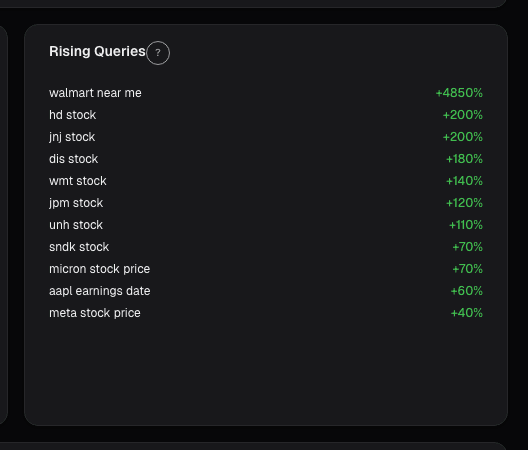
The Rising Queries card ranks the fastest-growing searches over the trailing 30 days:
- Query text: the search string as Google reports it
- Growth percentage or Breakout label, 200%, 400%, 1000%, or Breakout for anything above 5000%
- First-meaningful-volume date: roughly when the query started getting volume
- Bucket tag: product/feature, people/executive, risk/incident, or uncategorized
- Query volume estimate: relative scale (1–100) per Google Trends convention
Queries are bucketed via a lightweight lexicon pass on the query text, "CEO / CFO / founder / [known executive name]" → people bucket, "lawsuit / SEC / recall / outage / breach" → risk bucket, etc. The bucketing is heuristic, not perfect, but good enough to scan the risk column first when you have limited time.
Three query types and how to read them
Executive-name breakouts. A CEO, CFO, or founder name suddenly trending in rising queries frequently precedes or accompanies an official announcement (departure, promotion, testimony, personal scandal). The market often prices this within hours of news, but the search query can lead the news by 1–3 days because insiders, journalists, and connected people start googling before the public announcement. Action: check News for any story that's already broken; check Insider MSPR for any insider positioning in the preceding weeks. If news is silent but the query is spiking, something is in the pipeline that hasn't been announced yet.
Product-feature breakouts. "Brand] [new feature]" or "[product] review" queries typically rise in the run-up to product launches, media reviews going live, or developer-community chatter reaching scale. These lead revenue cycles by 2–8 weeks for successful launches and are an early read on consumer interest. A strong feature breakout on a name exposed to product-launch revenue is confirmatory; a weak breakout on a launch that was heavily anticipated is the yellow flag. Cross-check with [WSB Mention History, product breakouts often show up there too.
Risk-keyword breakouts. The most urgent category. "[Brand] lawsuit," "[brand] outage," "[brand] recall," "[brand] SEC," "[brand] breach", these queries spiking usually mean something material is happening that may or may not have hit major news outlets yet. Market takes hours to fully price risk events; queries often move within minutes. If a risk-bucket query has just broken out and news is silent, assume something is imminent and prepare accordingly (trim, hedge, or at minimum pay attention).
What doesn't work
- Single-mention queries. Google Trends requires baseline volume to report a query. If a query is hovering at the edge of reportability and briefly spikes, the signal is usually noise.
- Branded queries that are just the company name plus "price" or "quote." These always trend with volume. Not informative.
- Competitor-named queries. "[Competitor] vs [your ticker]" rising queries can mean anything, a blog post, a reddit thread, a product comparison. Low signal.
- Seasonal queries. Queries that spike every year at the same time (holidays, tax season) aren't narrative shifts; they're calendar effects.
Example: a product-launch front-run
In March 2025 I was tracking a consumer-tech mid-cap ahead of a new product announcement. The product had been pre-announced; the exact launch date was two weeks out. On Monday the Rising Queries card showed a breakout on "[product name] price" and "[product name] review." Neither query had meaningful volume a week earlier. The surge was too early for review coverage (product hadn't shipped) and too broad to be only insider-community chatter.
The interpretation: consumer interest in the product was running ahead of pre-launch consensus. Action: I held through launch rather than trimming as I'd planned. The product shipped well, consumer receivables exceeded guidance, stock rallied. I don't claim the queries predicted the rally, the rally had multiple drivers, but the early surge in consumer-intent queries was one of the corroborating signals that kept me in the trade instead of trimming on generic pre-launch nervousness.
Common mistakes
- Treating a breakout query as a trade signal. It's a prompt, not a signal. Act on it only after confirming with news, sentiment, or insider data.
- Ignoring risk-keyword breakouts. When "[brand] lawsuit" breaks out and you don't check, you're the last to know. Risk breakouts almost always reward immediate investigation.
- Over-interpreting uncategorized queries. The lexicon tags most queries, but the uncategorized bucket often contains noisy queries that don't map to a clear narrative bucket.
- Assuming queries will translate 1:1 to fundamentals. A consumer-interest surge for a product doesn't always translate to revenue, sometimes the interest is below the conversion threshold. Queries are a leading indicator, not a financial metric.
- Using only rising queries without the top-queries baseline. The two are complementary. Rising tells you the delta; top tells you the base. Read them together.
Where it fits
Rising Queries is the delta view on top of Interest Over Time (magnitude) and Top Queries (composition). Together they answer three questions that belong next to each other: how much interest, about what, and what's new. Pair with WSB Mention History and News on any breakout, almost always there's a correlated event someone else has already reported.
FAQ
How fresh are the rising-query data?
Google Trends refreshes the daily series typically within 24 hours. The card updates on that cadence. For intraday-scale rising queries, there's no equivalent public data.
What counts as a "Breakout" label?
Google Trends' own threshold is 5000% growth. Our card inherits that threshold; it reports the absolute growth number too so you can see whether something is a 200% move (moderate) or a true breakout.
Are these queries aggregated by country?
Default view is U.S. Global view is available via a toggle; for consumer-tech names with meaningful international exposure, the global view often catches international narrative shifts earlier than the U.S. view.
Why do I sometimes see obviously spam or bot queries?
Rare but possible. Google Trends filters most bot traffic but isn't perfect. A query that looks like keyword spam (long, unnatural phrasing, no obvious meaning) is usually safe to ignore. Our card doesn't filter these, because filtering risks hiding legitimate long-tail queries.
Can I set alerts on rising queries?
Yes, the Trade Alerts surface supports alert rules on specific query types (executive name, risk keyword, product feature) hitting breakout status on tickers in your portfolio or watchlist.
Related reading
- Google Trends Top Queries
- Google Trends Interest Over Time
- Congress Trades per Ticker
- Corporate Lobbying Spend
Open the Rising Queries card → /app/stocks/AAPL/sentiment
See it in the app
Live dashboard views that match this post. Each tile deep-links to the exact card.
Stocks mentioned
Related reading
Congressional Trades on a Single Stock
The 'Congress outperforms the market' story hides where the actual signal is. It's not aggregate Congressional portfolios, it's a single committee chair's…
Corporate Lobbying Disclosures
Lobbying spend publicly discloses which regulatory fights a company is fighting. A quarter-over-quarter jump in contacts to a new agency often precedes the…
Dark Pool Prints
Off-exchange share above 45% clustered into weakness signals institutional accumulation. Dark pool prints are regulated, post-trade transparent, and measurable.
Google Trends Interest Over Time
Search interest in a brand, product, or ticker often precedes revenue by weeks. Used correctly, same-week year-over-year comparisons, not absolute levels …
Top Related Queries
Top queries reveal narrative around a stock. Incident terms like lawsuit or breach in the top ten often surface days before mainstream financial media coverage.
Ready to try alphactor.ai?
Validate your trading strategies with statistical credibility testing. Start free.
Get Started Free