Tax-Loss Harvesting: The Free Lunch That Actually Exists
Tax-loss harvesting offsets gains without changing market exposure. Research puts the after-tax benefit at 1-2% per year: a real long-run advantage.
 Marcus Chen4 min read
The Concept in One Paragraph
Tax-loss harvesting means selling a position that has declined in value to realize a capital loss, then immediately buying a similar (but not identical) investment to maintain your market exposure. The realized loss offsets capital gains elsewhere in your portfolio, reducing your tax bill. Your portfolio stays invested in roughly the same assets. The tax savings are real money in your pocket.
In an industry full of overpromised strategies, tax-loss harvesting is one of the few that delivers a genuine, measurable benefit with minimal downside. Research suggests it adds 1-2% per year in after-tax returns for taxable accounts. Compounded over 20 years, that is a meaningful difference in terminal wealth.
How It Works, Step by Step
Step 1: Identify positions trading below your cost basis. If you bought 100 shares of a stock at $50 and it now trades at $35, you have a $1,500 unrealized loss. Unrealized losses do not help you at tax time. You need to sell to realize them.
Step 2: Sell the losing position. This crystallizes the loss. You now have a $1,500 realized capital loss on your tax records.
Step 3: Immediately buy a replacement. To maintain your market exposure, buy a similar but not substantially identical security. If you sold an individual energy stock, you might buy an energy sector ETF. If you sold a broad market ETF, you might buy a similar ETF from a different provider (selling VOO and buying IVV, for example).
Step 4: Use the loss to offset gains. At tax time, the $1,500 loss offsets $1,500 of realized capital gains. If you have no gains, you can deduct up to $3,000 of losses against ordinary income. Excess losses carry forward indefinitely.
The Wash Sale Rule
The IRS imposes one critical restriction: the wash sale rule. If you sell a security at a loss and repurchase the same or a "substantially identical" security within 30 days before or after the sale, the loss is disallowed.
What counts as substantially identical:
- The same stock or ETF you sold
- Different share classes of the same fund
- Options on the same security
What generally does not count as substantially identical:
- Two ETFs tracking different indexes in the same sector
- An individual stock and a sector ETF that holds it
- Two different companies in the same industry
The 30-day window applies in both directions. Buying a replacement before selling the original, within 30 days, still triggers the rule.
When to Harvest
Year-round, not just in December. Losses are available to harvest whenever they exist. A stock that drops 20% in March and recovers by October offered an opportunity that only existed for a few months. Systematic monitoring captures more than a year-end-only approach.
After market drawdowns. A 10-15% decline creates harvesting opportunities across many positions simultaneously. The March 2020 sell-off was a harvesting bonanza. Positions profitable in February suddenly had losses available to realize.

When you have realized gains to offset. If you sold a position earlier in the year at a gain, actively look for losses to harvest. The gain creates a tax liability; the harvested loss reduces or eliminates it.
What to Watch For
Do not let the tax tail wag the investment dog. If a position is down but your thesis is intact, harvesting the loss and buying a replacement makes sense. But do not sell a high-conviction position just for the tax benefit if no adequate replacement maintains your desired exposure.
Track your cost basis carefully. After harvesting, your replacement security has a lower cost basis. This means you will pay more tax when you eventually sell it. Tax-loss harvesting is primarily a tax deferral strategy, not tax elimination. The value comes from deferring the liability, investing the savings, and compounding the difference.
Consider state taxes. Harvesting is more valuable in high-tax states. A California investor in the top bracket benefits at both the federal level (up to 23.8% on long-term gains) and state level (up to 13.3%), a combined marginal benefit exceeding 37%.
A Realistic Annual Impact
Consider a $500,000 taxable portfolio. In a typical year, you might harvest $15,000-$25,000 in losses. At a combined rate of 30%, that is $4,500-$7,500 in annual tax savings. Over a decade, systematic harvesting at this scale could save $50,000-$80,000 in cumulative taxes, depending on market volatility and portfolio turnover.
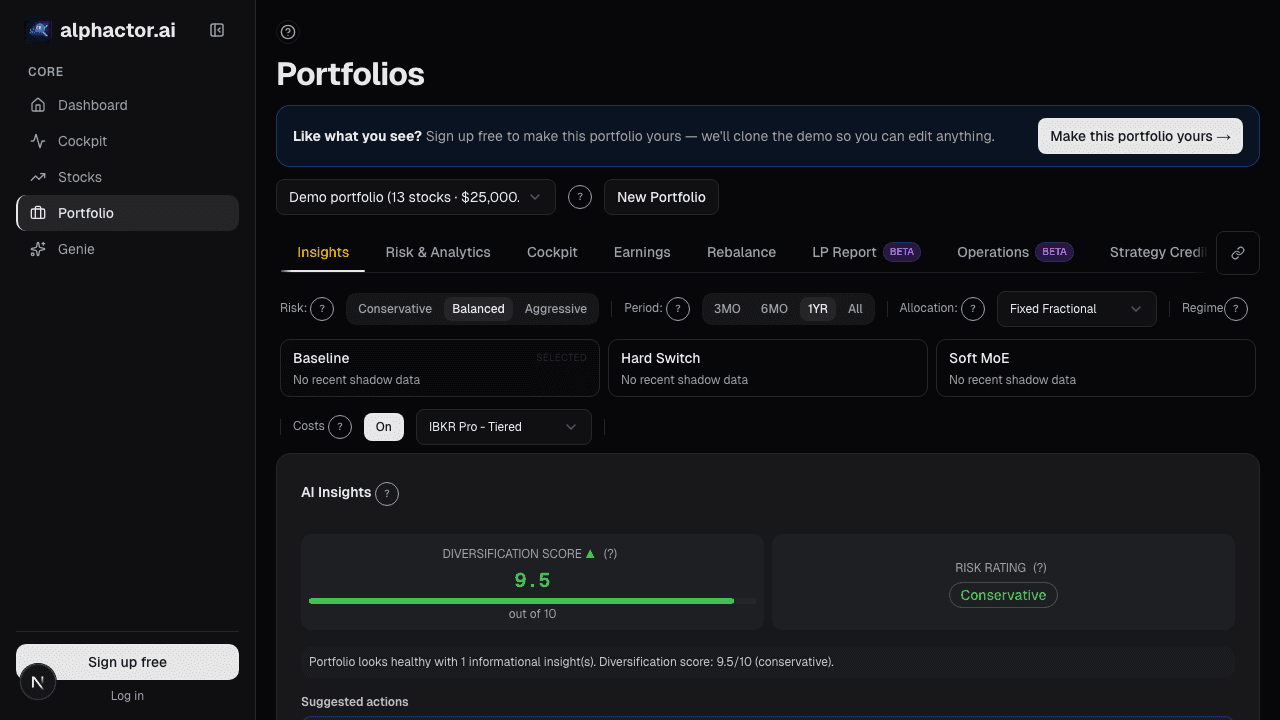
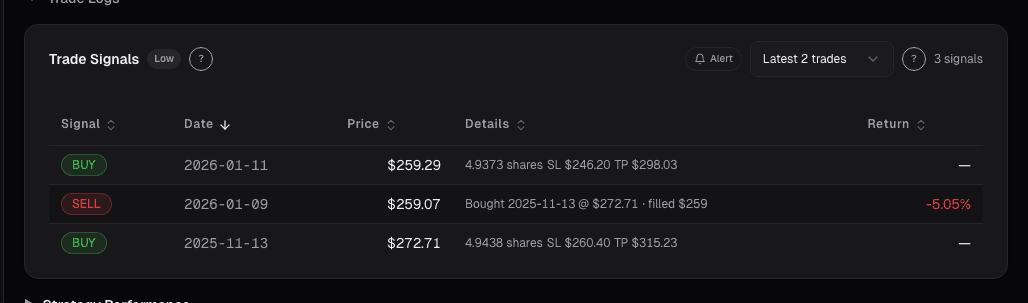
Alphactor's portfolio dashboard flags positions trading below cost basis, making it straightforward to identify harvesting candidates without manually checking each position. You can also set up trade alerts to get notified when positions cross below your cost basis. Pairing this with quarterly rebalancing creates a natural workflow: review allocations and harvest available losses in a single session.
Who Benefits Most
Tax-loss harvesting is most valuable for investors in high tax brackets with taxable accounts (not IRAs or 401(k)s, where gains are not taxed annually). It is least valuable for low-bracket investors, those holding only tax-advantaged accounts, or buy-and-hold investors with very low turnover.
If you have a taxable account and you are not harvesting losses, you are leaving real money on the table. The benefit is arithmetic, not speculative.
See it in the app
Live dashboard views that match this post. Each tile deep-links to the exact card.
Related reading
Choosing the Right Benchmark (Hint
Why benchmarking against the wrong index distorts your performance assessment and how to select a benchmark that matches your actual portfolio.
Alt-Data Sentiment at the Portfolio Level
Per-ticker alt-data breaks down past 10 positions. A roll-up of WSB, news, MSPR, and options lets a 90-second scan replace 100 minutes of manual checking.
Portfolio Attribution: Where Your Returns Actually Come From
Beating the benchmark by 400bps feels good until attribution tells you it was all allocation luck on one sector call. Selection vs. allocation vs.
Portfolio Audit Trail: Every Decision
Regulated managers need an audit trail. The Audit Trail card on alphactor.ai records every trade, rebalance, alert, and note into one timestamped log you…
Portfolio Credibility
Conviction is self-reported; credibility is externally anchored. The two diverge exactly where mistakes live, an 8% position in a name you love with a…
Ready to try alphactor.ai?
Validate your trading strategies with statistical credibility testing. Start free.
Get Started Free