Alt-Data Sentiment at the Portfolio Level
Per-ticker alt-data breaks down past 10 positions. A roll-up of WSB, news, MSPR, and options lets a 90-second scan replace 100 minutes of manual checking.
 Marcus Chen6 min read
Midway through 2024 I counted the number of alt-data surfaces I was trying to monitor across a 35-position book: WSB mentions per ticker, news sentiment per ticker, insider MSPR per ticker, unusual options activity per ticker, congressional disclosures per ticker. Five streams, 35 positions, call it ~175 individual dashboards. I'd been checking maybe eight of them per day and telling myself that was thorough. It wasn't. It was a random 5% sample of my alt-data surface with enormous blind spots. The only way to actually watch all of it was to aggregate, roll the per-ticker signals up to a portfolio view where I could scan the whole book in 90 seconds and drill into only the positions where something had moved.
This post is about the Portfolio Alt Sentiment card, how to use roll-ups without losing source-level nuance, and the two rules that keep the feed signal-heavy rather than noise-heavy.
TL;DR
- Per-ticker monitoring doesn't scale past 8–10 positions. The math doesn't work.
- Roll-ups compress per-ticker signal into a scannable portfolio view. Same information, 1/40th the attention budget.
- Multi-source confirmation is the noise filter. Single-source spikes are usually noise.
- Weight by position size. A signal on a 4% position deserves more attention than one on a 0.3% position.
- Roll-up + drill-down is the workflow. Never act on the roll-up alone; the source view is where you make the call.
Sentiment at portfolio scale
Per-ticker sentiment tools are individually useful and collectively impossible to use manually. A 40-position portfolio has roughly 200 possible sentiment-surface × position combinations. Even at 30 seconds per check that's a 100-minute daily scan, which nobody actually does, meaning in practice you're monitoring 10–15% of your book's alt-data surface on any given day. The positions you're not watching are statistically as likely to have moves as the ones you are.
A portfolio-level roll-up solves this by treating alt-sentiment as a monitoring problem rather than a research problem. The roll-up isn't where you do analysis; it's where you notice the 3 positions out of 40 where *something happened in the last day*. Drill in on those 3, skip the 37. The 90-second scan replaces the 100-minute one.
What the Alt Sentiment card shows
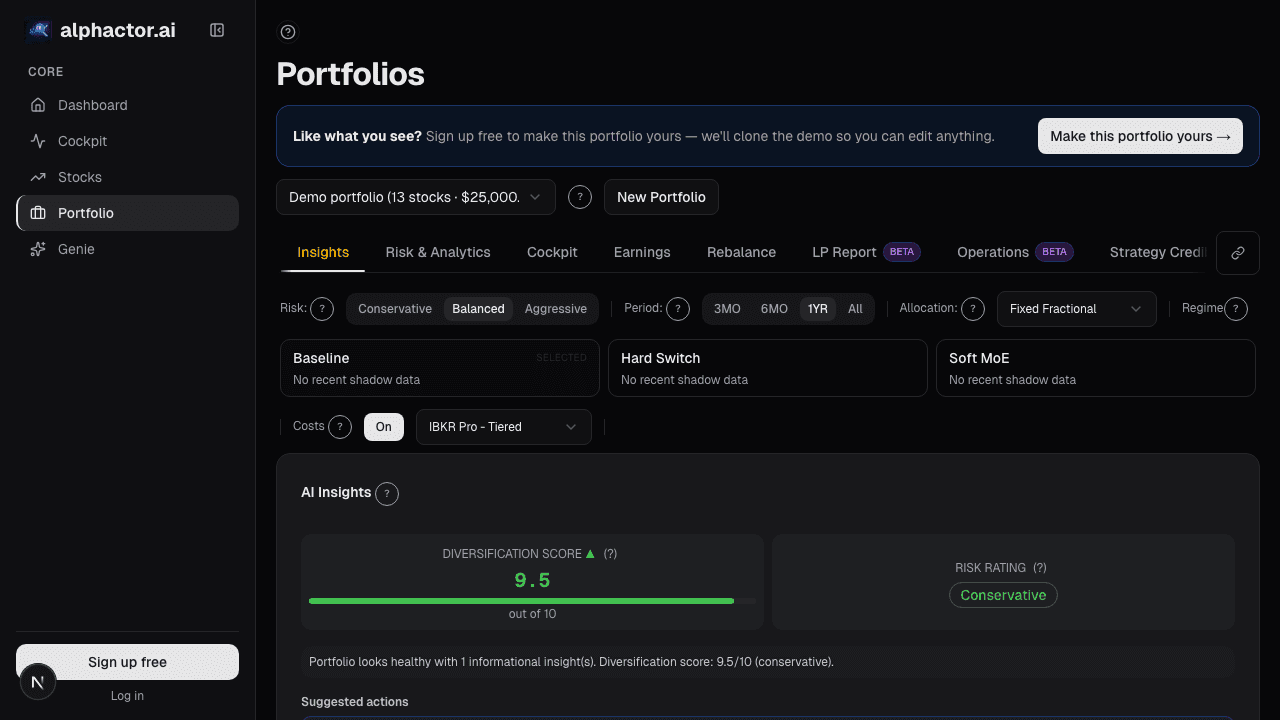
The Portfolio Alt Sentiment card rolls up four streams across every holding:
- WSB mention Z-score: standardized mentions vs. the ticker's trailing baseline
- News sentiment 7-day delta: sentiment score change vs. prior-week baseline
- Insider MSPR trend: Month-over-Month change in insider buy/sell ratio
- Unusual options activity hit count: days in the last week with flagged unusual flow
Each position shows a composite score (0–100) and the per-source breakdown. The top 5 rising and top 5 falling positions are pinned. A "new since yesterday" filter shows only names where at least one source crossed the 20th-percentile threshold in the last 24 hours, which is what's actually worth looking at most mornings.
The composite score isn't a mechanical weighted average. It's rank-based (each source's 7-day Z-score is percentile-ranked within the user's portfolio, then averaged), so a single outlier source doesn't dominate the composite.
Two rules that keep the feed signal-heavy
Require multi-source confirmation. A composite change driven by a single source is almost always noise. WSB spiking on a ticker because of one viral post doesn't mean anything about the stock; news sentiment spiking on a boilerplate analyst reiteration doesn't mean anything either. When two or more of the four sources move in the same direction in the same window, the pattern is rarer and meaningful. The card's default filter shows single-source events too, because sometimes you want to see them; my personal workflow filters to "2+ sources in agreement" by default.
Weight the signal by position size. A sentiment shift on your 4% position is more actionable than an identical shift on your 0.3% position. The card sorts by sentiment × weight so big-impact changes rise to the top. The 0.3% position's sentiment signal isn't noise, it's just lower-priority given your book. If you're adding to positions based on sentiment, the weight-adjusted view tells you where new size would be least disruptive relative to existing exposure.
Source-level drill-down
Roll-ups are not where you make decisions. They're where you decide what to examine. When the card flags a position:
- For WSB spike: drill into WSB Mention History to see context, top posts, and whether the mention spike is about this stock specifically or it's being mentioned alongside others.
- For news sentiment delta: drill into Sentiment News to read the actual stories and decide whether the sentiment shift is durable or a single-story artifact.
- For insider MSPR trend: drill into Insider MSPR to see individual transactions, the filing pattern, and whether it's 10b5-1 planned vs. discretionary.
- For unusual options activity: drill into Unusual Options Activity to see specific contracts, flow direction, and size.
Without the drill-down the roll-up is decorative. With it, the roll-up compresses a 100-minute manual scan into a 90-second triage that surfaces the 3–5 positions where real deeper work is warranted.
Example: a multi-source confirmation
Last October the card flagged one of my positions as a "top 5 rising" with three sources moving in agreement within 48 hours: WSB mentions spiked 3.2σ above baseline, news sentiment delta rose from +0.1 to +0.7, and unusual options activity showed 3 days of flagged bullish flow. Insider was flat. The composite score moved from 42 to 71.
Drill-down took 10 minutes across the three drill-in surfaces. WSB was about an earnings pre-announcement leaked earlier that week. News sentiment was the same story picked up across five outlets. Options flow was bullish OTM calls for the earnings week. The picture was consistent: market was repositioning for a positive earnings surprise. I didn't act on the long (earnings was 4 days out and I don't trade into earnings in that direction), but I did trim my underweight and size the position back to neutral. Earnings beat; stock gapped up 6%. The roll-up was what alerted me at 7am that day with the composite change; the drill-downs were where the actual decision was made.
Common mistakes
- Acting on the roll-up alone. The composite score is a triage signal, not a trade signal. Drill in.
- Ignoring single-source events entirely. Sometimes they're meaningful. The filter-to-2+-sources is a default, not a rule.
- Treating the card as a screener. It's not. It's a monitoring layer on positions you already hold. For new-name ideas, use the screener.
- Not re-weighting when positions change. As you add / trim / exit positions, the sort re-weights. But if you bulk-rebalance and don't check the card after, you may miss that a formerly-huge position is now smaller and the priority order has changed.
- Over-fitting to the composite threshold. The 20th-percentile threshold is reasonable but not sacred. Tune if it's surfacing too many or too few events.
Where it fits
The card feeds naturally from the per-ticker sentiment pages. When it flags a position, drill into that ticker's Insider MSPR, Unusual Options Activity, and WSB Mention History for source-level views. Combine with Webhook Alerts to get pushed when a composite threshold is crossed outside of market hours.
FAQ
How often does the card update?
Each source updates on its own cadence (news intraday, insider disclosures within hours of filing, WSB and options hourly during market hours). The composite recomputes as sources update.
Why four sources and not more?
The four chosen cover the major flow categories: retail (WSB), professional media (news), corporate (insider), and derivatives (options). More sources would dilute the signal with correlated information. If additional sources (Google Trends, congressional flow) are useful for specific positions, check those sources directly.
Can I add custom sources?
Not currently as user-configurable sources. The roll-up is fixed at the four streams. If you want additional sources in the composite, drop a feature request, we've heard the ask a few times.
Is this useful for passive / index portfolios?
Less so. Alt-sentiment is an alpha-overlay tool; for passive book holders there's limited reason to monitor per-position sentiment.
How big of a portfolio does this pay off for?
Break-even somewhere around 12–15 positions. Under that, per-ticker direct monitoring is manageable; over that, the roll-up saves real time.
Related reading
Open the Alt Sentiment card → /app/portfolio
See it in the app
Live dashboard views that match this post. Each tile deep-links to the exact card.
Stocks mentioned
Related reading
Choosing the Right Benchmark (Hint
Why benchmarking against the wrong index distorts your performance assessment and how to select a benchmark that matches your actual portfolio.
Brinson Attribution: Did You Pick Good Stocks
Brinson-Fachler splits active return into allocation, selection, and interaction so you can tell whether outperformance came from sector bets or stock-picking.
From Signal to Action
Cockpit panels aggregate signals across your portfolio and watchlist into a single actionable view. Learn how to use them for daily monitoring.
Custom Compliance Rules: Build Guardrails for Your Portfolio
How to use Alphactor's compliance rules to enforce position limits, sector caps, and risk thresholds automatically across your portfolios.
Concentrated vs Diversified: The Portfolio Sizing Debate
The tradeoffs between concentrated and diversified portfolios, with practical guidance on how many stocks you actually need.
Congressional Trades on a Single Stock
The 'Congress outperforms the market' story hides where the actual signal is. It's not aggregate Congressional portfolios, it's a single committee chair's…
Ready to try alphactor.ai?
Validate your trading strategies with statistical credibility testing. Start free.
Get Started Free