WallStreetBets Mention History
WSB mention spikes predict volatility but not direction. The Z-score is the usable metric; confirmation from insider or options data is required before acting.
 Jake Morrison6 min read
A few weeks after the initial GME squeeze in early 2021 I watched a different mid-cap retailer see a WSB mention Z-score of 4.2 over a three-day window. It was trending on the front page of the subreddit; short interest was elevated but not crazy; the company had positive news that week but nothing earth-shaking. My instinct said "follow the meme", this was the squeeze-inspired environment and I'd just watched GME run 20×. What actually happened: the stock ran 15% intraday on the Wednesday, gapped down 22% on Thursday as the mention momentum broke and short covering exhausted, and finished the week net -9%. The Z-score spike had correctly predicted volatility; it had said nothing useful about direction. I'd been treating mention volume as a conviction signal rather than an attention signal, and I paid for the confusion with about 12% of account equity that week on a position I had no business being in. Since then I've used mention spikes to *size down*, not to direct-trade.
This post is about the WSB Mention History card, why mention volume is a two-sided signal, and the three rules that make retail-attention data usable rather than dangerous.
TL;DR
- Mentions predict volatility, not direction. Ten-sigma spikes run both ways.
- Early spikes tend to follow; late spikes tend to fade. Context of the prior-period price move matters.
- Cross-check with insider and options flow before acting. Single-source retail signals are the most dangerous.
- Meme-name short-dated options are IV traps. Premium is already pricing the chaos.
- The Z-score is the usable number. Raw mentions drift with subreddit size over time.
Retail attention is a two-sided signal
Social mention spikes on r/wallstreetbets and similar forums predict short-term volatility reliably. What they don't predict reliably is direction. A 10× mention spike sometimes precedes a 40% rip and sometimes a 40% drop, and distinguishing the two requires context the mention count alone doesn't contain.
The mistake is treating mention volume as directional, it's an *attention* metric, not a conviction one. People post to WSB because something notable is happening to the stock, not because they have a specific view that will come true. The posts are downstream of attention, not of edge. What's tradeable is the interaction between attention and other signals you already trust: if WSB is spiking *and* insiders are buying *and* options flow is bullish, the attention is confirming a pattern other signals already suggested; if WSB is spiking alone, attention is the whole thesis and it's a weak one.
What the WSB Mention History card shows
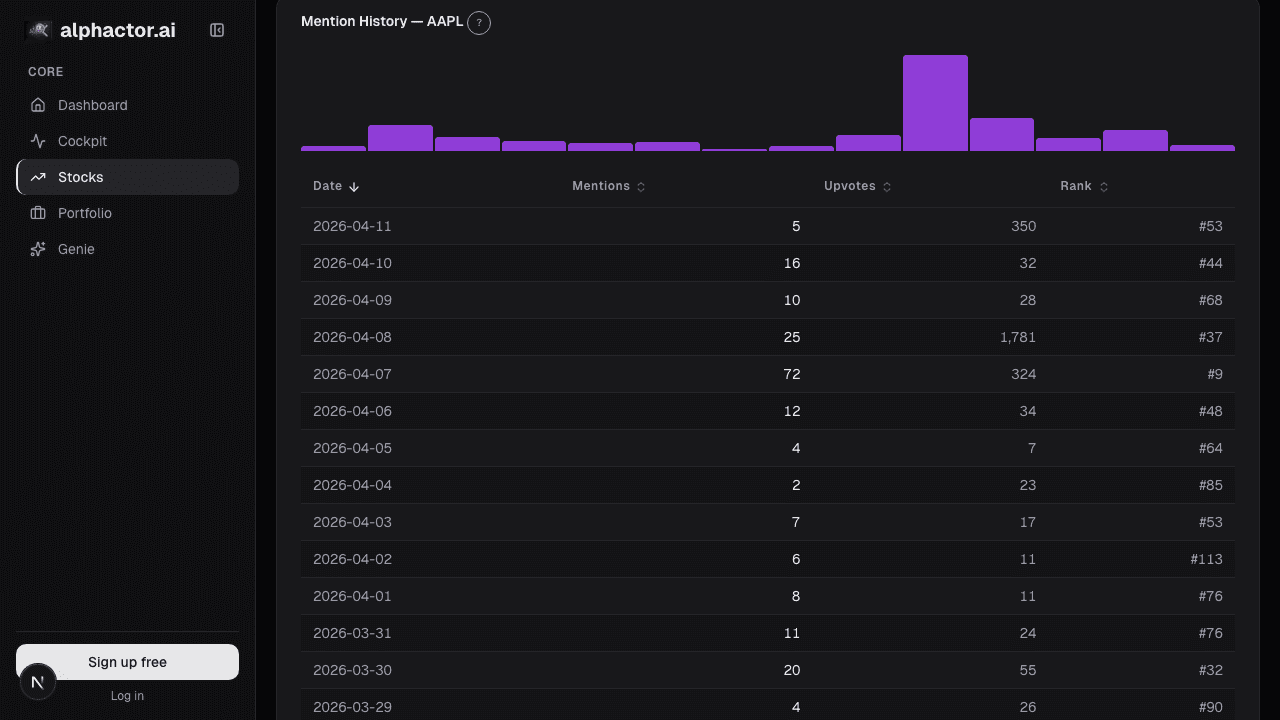
The WSB Mention History card plots:
- Daily mention counts over the trailing 90 days for the ticker
- Z-score: mentions today vs. 20-day mean/stdev; Z > 3 is unusual, Z > 5 is trending
- Bullish/bearish sentiment score derived from NLP over post titles and top comments
- Secondary chart overlaying mention count against price so lead/lag patterns are visible
- Top posts of the week: the posts driving the attention, so you can read the context
- Commenter-uniqueness score: whether the mentions are from many distinct accounts or a few prolific posters (the latter is lower-quality signal)
The Z-score is what's actually useful. Raw mention counts drift with subreddit size over multi-year horizons; Z-scores are stable across that drift.
Using it without getting burned
Fade late spikes, follow early ones. A Z > 5 spike that occurs *after* a 30%+ multi-week run is usually distribution, retail is last in. A Z > 5 spike that occurs *before* the run has started (price still near base, no recent breakout) is early attention worth considering. The mental model: if the crowd is arriving after a move, the move is probably over; if the crowd is arriving before a move, you're earlier than most. Exception: some names keep running post-initial-spike (the 2021 meme environment), but that's regime-specific and not a base case.
Require confirmation from another domain. If WSB is spiking and Insider MSPR is red (insiders selling), the retail story is on a clock, insiders are taking the other side of the retail flow, and they usually know more than the crowd. If WSB is spiking and insiders are also buying, and options flow shows bullish positioning, you have a converging signal. The single-source WSB spike is the dangerous one.
Short-dated options on meme spikes are an IV trap. By the time the mention spike is visible, implied volatility is already pricing the noise. A seemingly cheap call option is cheap because IV hasn't exploded yet; once the IV bakes in, you're paying the vol premium for limited directional upside. Check Options Key Metrics for IV rank before buying premium into a WSB burst. IV rank > 70th percentile on a meme spike is usually a reason to sell premium, not buy it.
Example: a confirming signal that worked
Small-cap name I watched in mid-2024. Over a 10-day window:
- WSB mention Z-score: 0.8 → 4.2 (unusual spike)
- Sentiment: bullish (65% positive comments)
- Commenter-uniqueness: 180 distinct accounts (diverse, not a pumping ring)
- Insider MSPR: positive for 8 weeks (CEO and two VPs bought)
- Options flow: bullish OTM calls with above-average size for three sessions
- Price context: had consolidated for 4 weeks, not in a post-run state
All four sources were pointing the same direction, early in what might become a move. I took a small long position. Stock ran 28% over the following 3 weeks. Not because of WSB alone, because of the convergence. Without the insider and options confirmation I'd have sized down or passed; WSB alone was not enough.
What mention volume doesn't tell you
- Whether retail is right. Retail has been right during specific regimes (2021) and wrong during others. The signal doesn't say which you're in.
- Whether the thesis is durable. Meme attention can evaporate in days; the underlying reason for the attention may or may not persist.
- What the institutional flow is doing. Retail and institutional flow can be aligned (rare) or opposed (common). Don't infer institutional positioning from retail activity.
- Whether there's fraud or manipulation. Some pump-and-dump schemes use WSB to inflate attention; commenter-uniqueness helps identify these but isn't a perfect filter.
Common mistakes
- Treating mentions as a directional signal. They're attention, not direction.
- Trading single-source WSB signals. Without confirmation, you're betting on a crowd whose edge is unclear.
- Ignoring IV context on options. IV is the first thing the mention spike prices in; cheap options on a meme aren't cheap.
- Buying post-run spikes. Late attention is the tell that the trade is finished.
- Shorting meme stocks without sizing for squeeze risk. A meme with high short interest and WSB attention has convex upside risk; short the name only if you're comfortable with 50%+ move against.
Where it fits
WSB attention is a rate-of-change signal, not a standalone thesis. It answers "is this name about to get more volatile?" better than "should I buy this?" Pair with Dark Pool prints and Unusual Options Activity to see whether institutions are positioned alongside the retail flow (bullish confirmation) or on the other side (short interest, fade setup). For the portfolio-level view across holdings, use Portfolio Alt Sentiment to triage which of your names need attention.
FAQ
How frequently does the card update?
Hourly during market hours, less frequently overnight. Reddit data is pulled from public JSON endpoints; no user content is scraped into our posts.
What counts as a "meme" name?
No formal definition in the card. Any name with sustained Z-score > 3 and broad commenter participation is the operational definition. Historical meme names (AMC, GME, BBBY) are tagged as such for reference.
Does the sentiment score work well?
Moderately. It's accurate at the bullish/bearish axis for straightforward posts; sarcasm, hedging, and finance-specific irony are harder. Treat it as a directional indicator, not a conviction measure.
Can I alert on WSB spikes?
Yes, Trade Alerts supports Z-score threshold alerts with ticker filters. Common rule: fire on Z > 4 with insider-MSPR confirmation for watchlist names.
Are other subreddits included?
Primary source is r/wallstreetbets; r/stocks and r/investing are included with lower weight because their signal tends to lag. No niche subs.
Related reading
Open the WSB Mention History card → /app/stocks/AAPL/sentiment
See it in the app
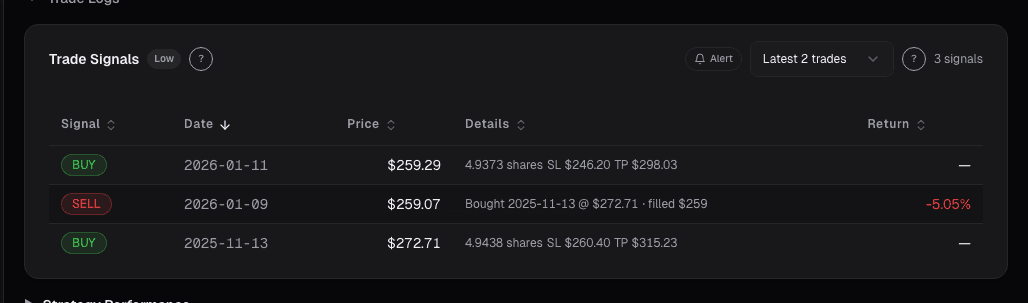
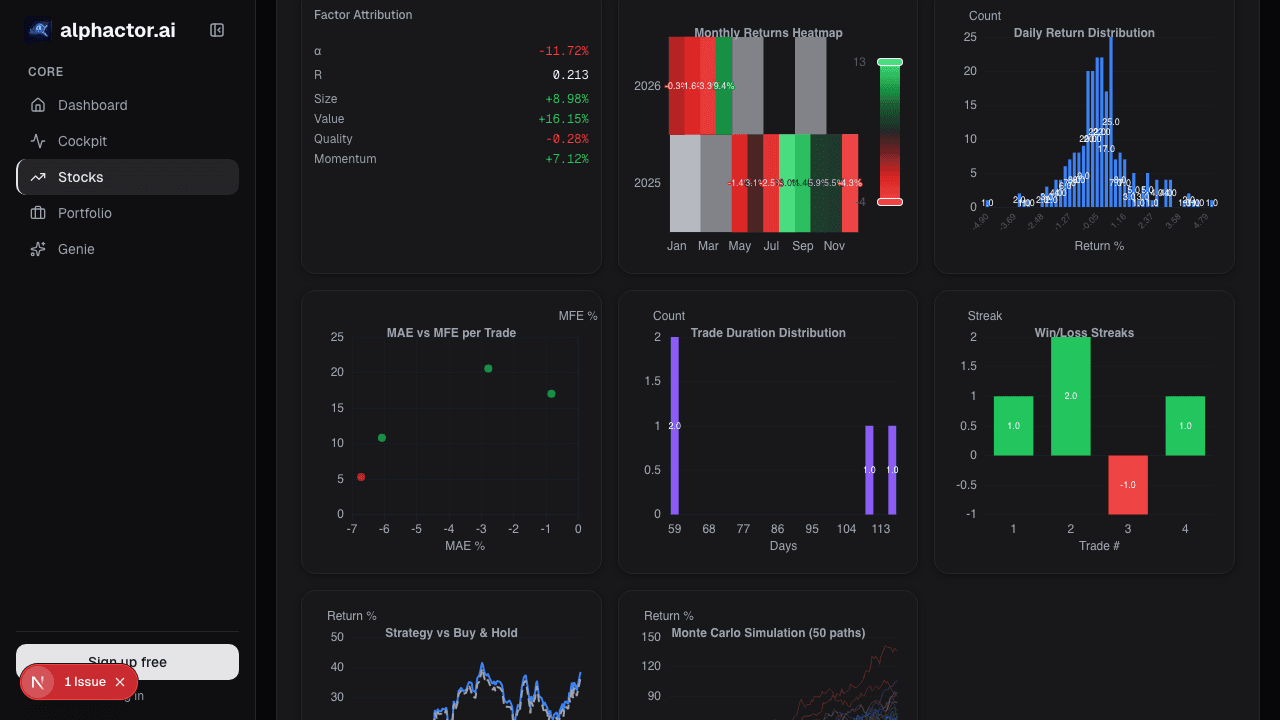
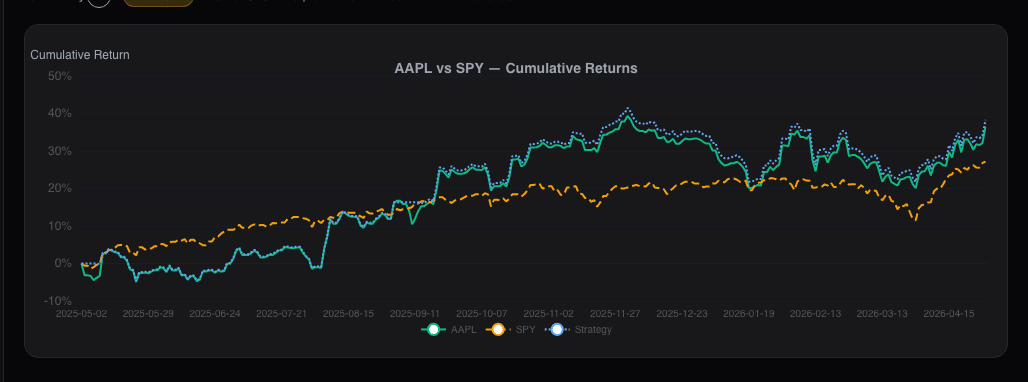
Live dashboard views that match this post. Each tile deep-links to the exact card.
Stocks mentioned
Related reading
Congressional Trades on a Single Stock
The 'Congress outperforms the market' story hides where the actual signal is. It's not aggregate Congressional portfolios, it's a single committee chair's…
Corporate Lobbying Disclosures
Lobbying spend publicly discloses which regulatory fights a company is fighting. A quarter-over-quarter jump in contacts to a new agency often precedes the…
Dark Pool Prints
Off-exchange share above 45% clustered into weakness signals institutional accumulation. Dark pool prints are regulated, post-trade transparent, and measurable.
Dashboard News: A Filtered Stream Across Your Holdings
Generic news feeds drown you in noise. The Dashboard News card filters by your holdings and ranks by sentiment impact: what's new, what matters, why.
Leaderboards and Social Profiles
How Alphactor's leaderboards rank users by verified strategy performance, and how social profiles help you find traders worth following.
Ready to try alphactor.ai?
Validate your trading strategies with statistical credibility testing. Start free.
Get Started Free