Margin of Safety
The discount between a stock's market price and an analyst's estimate of intrinsic value.
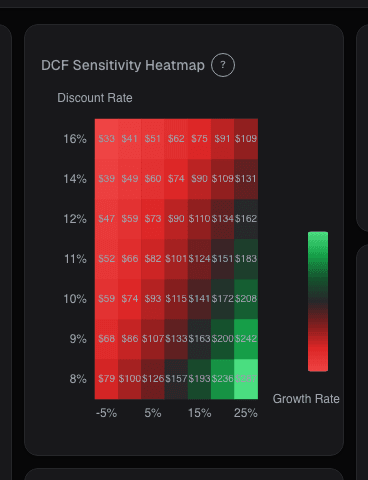
Coined by Benjamin Graham, the margin of safety is the cushion an investor insists upon to protect against errors in valuation, adverse events, or simple bad luck. If intrinsic value is $100 and you demand a 30% margin of safety, you only buy at $70 or below.
Why it matters. Every valuation model has input error. Growth, margins, cost of capital, each assumption compounds. A margin of safety ensures that even if one or two assumptions are wrong, the position is still profitable.
Pitfalls. A margin of safety applied to a flawed intrinsic value is worthless. Do the bull/base/bear scenario analysis *first*, then demand your discount from the *base* case. A "30% off the bull case" looks cheap and isn't.
See it applied
Related reading
- EV/Revenue: The Multiple That Survives When Earnings Don't
EV/Revenue survives where P/E breaks, but needs a growth bridge. Pre-profit software mid-cycle runs 0.2-0.4x growth-adjusted, how to avoid the reading traps.
- FCF Yield: What You're Actually Earning Today
FCF yield answers the most basic question in equity investing: if I buy this company today, how much cash does it throw off per dollar?
- Earnings Power Value
EPV asks what a company is worth assuming zero growth, forever. The gap between EPV and market cap is the growth premium.