Discounted Cash Flow (DCF)
An intrinsic-value model that discounts a company's projected free cash flows back to today at a required rate of return.
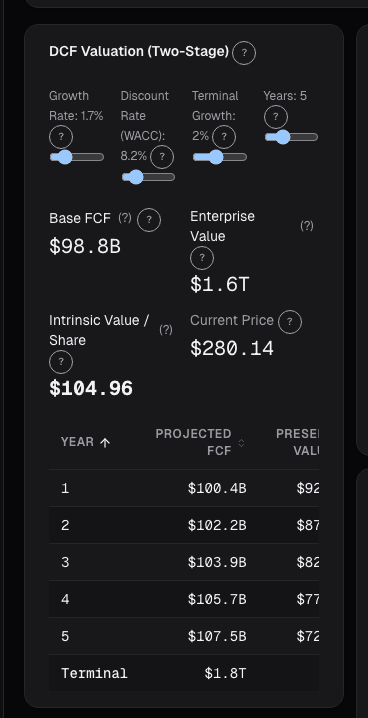
A DCF model estimates what a business is worth today based on the cash it is expected to generate in the future. You project free cash flow (FCF) over a forecast period, typically 5 to 10 years, add a terminal value for everything after that, and discount the stream back to the present using a discount rate (usually the weighted-average cost of capital).
Core formula. `Intrinsic value = Σ FCFₜ / (1 + r)ᵗ + TV / (1 + r)ⁿ`, where `r` is the discount rate and `TV` is the terminal value.
Why it matters. A DCF forces you to defend three assumptions: growth, margins, and the cost of capital. Small changes in any of these produce wildly different fair values, so the output is best thought of as a *range*, not a point estimate. alphactor.ai runs a DCF on every covered ticker and publishes the bull/bear/base scenario on the analysis page.
Key pitfalls. Terminal value often accounts for >60% of the DCF output, so the terminal growth assumption is the single most important input. Over-engineering short-term projections while under-thinking the terminal rate is the most common failure mode.
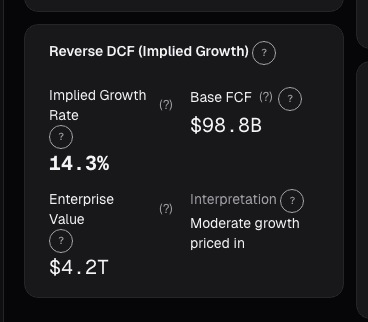
Reverse-DCF. Rather than plug in growth and solve for value, reverse-DCF takes the current market price as given and solves for the growth rate the market is implicitly assuming. If the implied growth exceeds what you can defend, the stock is priced for perfection.
See it applied
Related reading
- EV/Revenue: The Multiple That Survives When Earnings Don't
EV/Revenue survives where P/E breaks, but needs a growth bridge. Pre-profit software mid-cycle runs 0.2-0.4x growth-adjusted, how to avoid the reading traps.
- FCF Yield: What You're Actually Earning Today
FCF yield answers the most basic question in equity investing: if I buy this company today, how much cash does it throw off per dollar?
- Earnings Power Value
EPV asks what a company is worth assuming zero growth, forever. The gap between EPV and market cap is the growth premium.