Recent Alerts on the Dashboard: Your Rule Triggers
Alert fatigue is the silent killer of alert systems. The Recent Alerts card consolidates every rule-driven event into one stream you can triage in five…
 Marcus Chen7 min read
In 2023 I worked with a trader whose phone buzzed 180 times on a normal day. Price alerts, volume alerts, news alerts, portfolio webhooks, trading-platform notifications, three separate Slack channels, two email subscriptions. By month three he had silenced every single one of them, not selectively, just a blanket mute, because he could no longer tell which ones mattered. The system that was supposed to make him more responsive to his book had made him blind to it. That is alert fatigue, and it is the default outcome of any alerting system without deliberate triage design.
This post is about the Recent Alerts card, how to tune it so you actually read your alerts, and the three rules that keep alert streams usable over a full year of heavy use.
TL;DR
- Alert fatigue is the default outcome if you don't deliberately tune.
- The Recent Alerts card is one triage surface for every rule-driven event. Not the only place alerts land, but the one where you make the "act or defer" call.
- Tune aggressively. An alert that fires three times a week and you don't act on is noise; kill it.
- Acknowledge proactively. Unacknowledged alerts pile up until the pile itself becomes invisible.
- Tier your alerts. Urgent (market-hours, time-sensitive) vs. informational (sentiment drift, weekly review) should route differently.
Why alerts need a central view
The default alerting setup spreads events across email, push notifications, Slack, and maybe a webhook. Each channel has its own latency, its own visual weight, and its own history of being right or wrong. Nothing is consolidated. When a price breakout alert hits at 2:47 p.m. and a sentiment-change alert hits at 2:49 p.m. from a different channel, you are not processing them in comparison, you are processing them sequentially, from different inboxes, with different context.
A central alert view fixes that by collecting *every* rule-driven event into one stream, timestamped, chronologically sorted, with enough context on each row to make the "act or defer" call in ten seconds. It isn't the only place alerts land, you still get your SMS for time-critical price breaks, but it is the surface where you reconcile *what happened* with *what matters*.
What the Recent Alerts card shows
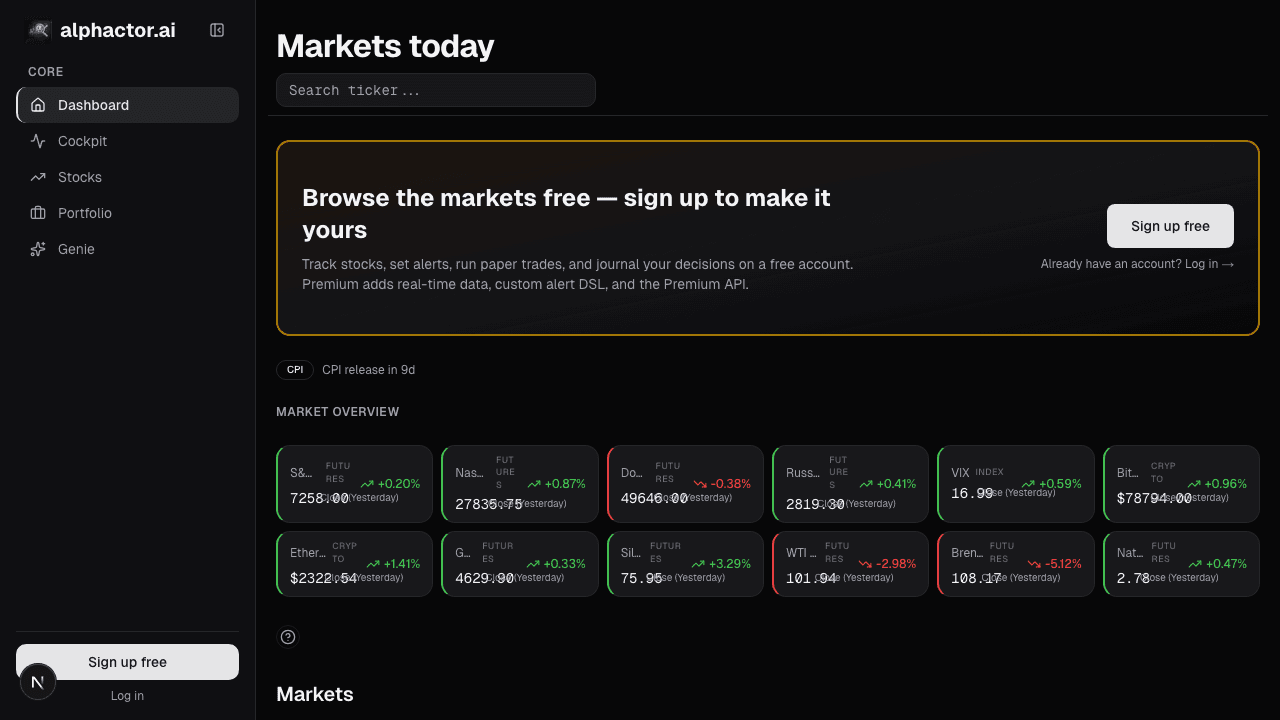
The Recent Alerts card consolidates every triggered alert from the past 48 hours:
- Alert name and trigger condition (e.g. "AAPL crossed 190" or "NVDA sentiment delta > +0.5")
- Ticker(s) affected and the current price / relevant metric
- Timestamp with both absolute time and "time since fired" (in market-hours or wall-clock depending on alert type)
- Source: price alert, trade alert, portfolio webhook, volume alert, regime-change alert, user-signal trigger
- Acknowledgment state: unacknowledged alerts pin to the top with a visual emphasis; acknowledged alerts sink below
Clicking through on a row takes you to the page where the alert was configured, so you can immediately tune, disable, or add to the rule. That two-click feedback loop is important, if tuning a noisy alert takes five minutes of menu-hunting, you won't do it, and the alert stays noisy.
Three rules that keep alert streams usable
Kill alerts you don't act on. The easiest rule. If an alert has fired three times in a week and you haven't taken an action on any of them, the rule is wrong. Either the threshold is too loose, the trigger condition isn't capturing what you actually want to know, or the alert was set up for a regime that's ended. Tune it down, narrow the condition, or kill the alert entirely. Alerts you don't act on are the single largest source of alert fatigue.
Acknowledge proactively. Unacknowledged alerts have an insidious failure mode: when there are three of them, you notice; when there are 30, you stop seeing the pile at all. The acknowledgment step is a habit, not a feature, at the end of your daily scan, clear every row to acknowledged state, even the ones you're not acting on. That keeps the visual cue meaningful when a genuinely urgent one comes in.
Tier your alerts by urgency. Price breaks during market hours are urgent, they should page you immediately via push or SMS. Weekly sentiment shifts or portfolio drift are informational, they should land only in-app where you can triage them on your schedule. Mixing tiers ("send everything to my phone") defeats the tiering; your phone becomes another version of the email inbox, indistinguishable signal-to-noise. The configuration for tiering lives in the per-alert settings; most alerts have sensible defaults if you leave them alone, but the manual override is there.
Triage workflow
A five-minute morning workflow for the Recent Alerts card:
- Scroll to the top of the card. Look at unacknowledged alerts first.
- For each unacknowledged row: is the underlying name still tradeable (still on my watchlist / in portfolio)? Is the alert still relevant (did the condition end or persist)? Is there action to take now?
- If action: take it (open a chart, look at sentiment, move to trade-planning), then acknowledge.
- If no action: acknowledge anyway so the row clears.
- Scan acknowledged rows from the past 24 hours only if a specific cluster catches your eye.
That's it. Under five minutes when the card is tuned; under ten when it's not. If you're spending more than ten minutes on this daily, your alerts are miscalibrated.
Example: a morning in late 2025
Last November I opened the dashboard on a Tuesday and the Recent Alerts card showed 14 unacknowledged rows from the previous afternoon and overnight:
- 4 price-breakout alerts on names in my watchlist (three in the same sector; one was a repeat from last week)
- 3 sentiment-delta alerts (one material, a position I own had rising news volume)
- 5 volume-spike alerts (two overlapping with the price breakouts; three on names I don't follow)
- 2 congressional disclosure alerts (one from my Armed Services committee rule, one from a freshman-member rule that had been too loose)
I acknowledged the 5 volume-spike alerts after a 30-second scan (no action, 2 duplicates of the price breakouts, 3 on non-watchlist names). The 3 price breakouts in the same sector drove me to open the sector ETF chart and note the cluster. The sentiment-delta on my position was worth a 5-minute read of the news. The Armed Services committee disclosure added to a thesis I was already building. The freshman-member alert fired on a trade I didn't care about; I tuned the rule to exclude freshmen. Total time: 14 minutes, one tune, one material read, one thesis update. That's what a well-tuned alert stream looks like on a normal day.
Common mistakes
- Setting alerts and never reviewing them. A six-month-old alert whose trigger condition no longer matches current regime is noise. Quarterly audit.
- Same alerts to multiple channels. Email, push, Slack, and in-app for the same event = 4× fatigue, 1× signal.
- Ignoring the acknowledgment state. The visual cue only works if you use it. Clear the queue daily.
- Too-loose thresholds. The temptation to catch every potential case makes the rule fire constantly. Tighten.
- Treating the card as a log to archive from. It's a triage surface, not an audit trail. Use the Audit Trail card for archival; use Recent Alerts for "what needs action now."
Where it fits
Recent Alerts sits above the individual alert configuration surfaces, Price Alerts, Trade Alerts, and portfolio Webhook Alerts. It pairs with User Signals (your custom rules, which also feed the alert stream) and Cockpit Overview (the always-visible event stream alongside your trade list).
FAQ
How long are alerts retained in the card?
48 hours by default for the dashboard view. The Audit Trail card has longer retention for post-hoc review.
Can I filter the card by source or ticker?
Yes, a filter bar at the top of the card supports source type (price / trade / volume / webhook / regime / user-signal), ticker, and acknowledgment state.
What happens if I miss an alert?
It stays in the card for 48 hours and goes into the audit trail after that. If it was a time-sensitive one (price break that's reversed by the time you see it), you missed the trade, but the record stays.
Should I have mobile push enabled for all alerts?
No. Only the urgent tier (price breaks during market hours, trade confirmations, critical risk events). Everything else in-app only.
Can I share alerts with a team?
Yes, portfolio webhook alerts can route to a shared Slack channel or email distribution list. Per-user alerts (price, trade) stay with the user who set them up.
Related reading
- Dashboard User Signals
- Dashboard Market Signals
- Dashboard Movers & Unusual Volume
- Dashboard News Stream
Open the Recent Alerts card → /app
See it in the app
Live dashboard views that match this post. Each tile deep-links to the exact card.
Related reading
Market Signals on the Dashboard: Macro Context in One Card
Every stock trade is partially a macro trade whether you want it to be or not. The Market Signals card condenses breadth, volatility, rates, and leadership…
Dashboard Movers: Catching Unusual Moves Before They're Old
Most platform movers lists are dangerous, they rank by % change alone, surfacing illiquid small-caps on meaningless volume.
Dashboard News: A Filtered Stream Across Your Holdings
Generic news feeds drown you in noise. The Dashboard News card filters by your holdings and ranks by sentiment impact: what's new, what matters, why.
The Prediction Heatmap
The prediction heatmap encodes probability shifts as color and saturation so you triage your whole watchlist in 30 seconds before opening a single chart.
User Signals: Your Custom Rules
The durable edge in retail investing is almost always a custom rule, a specific combination of factors nobody else is screening for the same way.
How to Set Up Trade Alerts That Actually Tell You What to Do
Most alert systems create noise you ignore within a week. This guide sets Alphactor alerts around strategy conditions so each notification stays worth reading.
Ready to try alphactor.ai?
Validate your trading strategies with statistical credibility testing. Start free.
Get Started Free