Part of: Fundamental Analysis
Government Contracts
Federal obligations are public within days via USAspending and typically flow to the issuer 2–4 quarters before appearing in a 10-Q.
 Marcus Chen7 min read
A defense prime I'd been patient on for six months quietly won a $2.8B IDIQ (indefinite-delivery indefinite-quantity) contract with the Navy in early 2024. The award showed up on USAspending within four days of obligation. The company didn't issue a press release for another two weeks, and the award only appeared in consensus analyst models a month after that when the next investor call acknowledged it. By then the stock had drifted up 9% as tape readers and gov-contracts-aware specialists had quietly been bidding. That 9% was the market absorbing publicly-available information at the rate that public information reaches the average analyst, which, for federal obligations data, is weeks slower than the data itself is available. I'd been watching the card daily; I added on the award. The stock ran another 20% over the subsequent three quarters as the contract cadence played out.
This post is about the Government Contracts card, why federal obligations are one of the lowest-latency public disclosures available, and the patterns that translate contract flow into revenue expectations.
TL;DR
- Federal obligations are public within ~48 hours via USAspending. Much faster than they appear in 10-Qs.
- For defense, aerospace, IT services, health, and infrastructure, federal revenue is 15–80% of total. The card matters most for these.
- Agency concentration shifts signal customer-concentration risk changes. Diversification away from one dominant customer is bullish through political transitions.
- Protest resolutions flip revenue direction without total obligations moving. The card flags these separately.
- Step-change quarterly obligations (+40% QoQ) typically precede revenue-guidance raises within 2 quarters.
Federal revenue is a leading indicator
Federal contract obligations are committed dollars that flow to the issuer over weeks or years. Unlike corporate revenue, which is reported quarterly on a ~45-day lag in 10-Qs, plus the time the analyst community takes to model it, obligations are recorded at award time and are public within days via USAspending. That means a material contract win shows up in the feed weeks or months before it lands in a 10-Q, and months before it reaches consensus analyst models.
For defense, aerospace, IT services, health IT, and infrastructure names, this is one of the highest-signal, lowest-latency public disclosures available. Pure-play federal contractors (LMT, NOC, LDOS, BAH, and similar) derive 60–95% of revenue from federal sources; diversified names (MSFT, ORCL, CSCO in the commercial-federal mix) are lower but still meaningful. The feed is more informative per unit of attention than earnings calls for these names precisely because it's less-watched despite being fully public.
What the Gov Contracts card shows
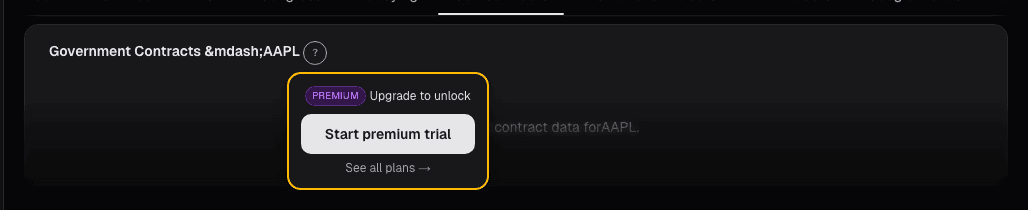
The Gov Contracts card aggregates awards where the issuer (including subsidiaries matched by SAM.gov NAICS/CAGE lookups) is the prime contractor:
- Total obligated dollars by quarter over a rolling 5-year window, with YoY and QoQ comparisons
- Top contracting agencies: which departments are the primary customers, sized by cumulative obligation share
- Award-count distribution: whether obligations come from a few large awards or many small ones (concentration risk vs. flow stability)
- Recent-awards table: last 30 awards with date, agency, description, obligated value, period of performance, and whether the award is fully funded or on an option structure
- Federal-fiscal-year view: October-September fiscal alignment for year-over-year comparison that matches federal budget cycles rather than corporate calendars
- Protest flags: awards under GAO protest, with resolution status and dollar amount of the disputed obligation
- Subsidiary match confidence: because federal awards are legally filed to the contracting entity (often a subsidiary or JV), the card shows match confidence so you can tell prime-awards from subsidiary-inferred awards
Reading the signal
Step-change quarterly obligations. A 40%+ jump QoQ in total obligations, sustained over two consecutive quarters, historically precedes revenue guidance raises for names where federal revenue exceeds 15% of total. The mechanism: awards committed in Q1 convert to revenue over the subsequent 2–6 quarters (IDIQ structure and period-of-performance determine the conversion pace), so management typically knows the run-rate is improving before it reports it. Watchers of the card see the leading indicator.
Agency concentration shifts. A move from diversified awards to one dominant customer signals emerging customer-concentration risk (bearish). Conversely, diversification away from a single agency reduces policy-cycle sensitivity and is bullish through political transitions. For a defense contractor, a shift from 70% Air Force to 35% Air Force / 30% Navy / 20% MDA spread is materially less exposed to any single budget-authorization dispute.
Protest resolutions. Contract protests at the GAO can result in awards being overturned or re-competed. A $500M award that was in the total for the prior quarter and is now reversed flips revenue direction without the raw total changing meaningfully in the next quarter (because it's replaced by the re-award or a different win). The card flags the protest separately so you can read through the noise.
Period-of-performance structure. A $2B IDIQ over 10 years is a different revenue profile than a $2B firm-fixed-price delivered in 18 months. The period-of-performance field lets you model the revenue flow-through. Award total alone is misleading on the fast/slow distinction.
Example: reading a 2024 IT-services cycle
Mid-2024 I tracked a federal IT services mid-cap. The obligations flow by quarter:
| Quarter | Obligations | QoQ | Top agency |
|---|---|---|---|
| Q3 2023 | $340M | , | VA (45%) |
| Q4 2023 | $380M | +12% | VA (42%) |
| Q1 2024 | $620M | +63% | DoD (38%), VA (30%) |
| Q2 2024 | $660M | +6% | DoD (40%), VA (28%) |
The step-up in Q1 2024 was driven by three large DoD cybersecurity awards. The company hadn't issued a press release on any of them. Consensus was modeling 6% revenue growth for the year; the obligations run-rate implied closer to 18%. Over the next two quarters the company raised full-year guidance twice, and the stock moved from $42 to $61. The obligations signal had been visible from the feed the day of the Q1 2024 awards; consensus caught up two quarters later. I was long from $46, trimmed at $58, finished at $60. The card's daily-updated obligations line did most of the timing work.
What the card can miss
- Commercial contracts. Only federal awards are captured. A contractor with meaningful state/local or commercial revenue won't see those flows here.
- Subcontractor awards. Prime contracts are captured; subcontractor flows from primes to subs are not consistently filed to USAspending. For names that primarily sub-contract, the feed understates.
- Classified contracts. Intelligence-community and some DoD special-access awards aren't publicly reported. For names with significant classified revenue, the feed is incomplete.
- Obligation-to-revenue timing. The card shows obligations, not recognized revenue. The mapping between the two depends on contract structure (firm-fixed-price vs. cost-plus vs. IDIQ), and a naive "obligations = revenue" read will be wrong.
- M&A distortion. An acquisition changes the subsidiary match overnight. The card flags M&A quarters for manual review.
Common mistakes
- Treating obligations as revenue. They're not. The conversion takes quarters, depends on contract type, and is subject to de-obligation if the contract is modified.
- Ignoring the protest column. A $1B protested award isn't the same as a $1B unprotested one. Read the status.
- Focusing on totals without agency mix. Customer concentration changes are often more informative than aggregate dollars.
- Reading a single quarter. Federal award cadence is lumpy; 4-quarter rolling is the cleaner view.
- Forgetting about subsidiary matching. For conglomerates, the subsidiary roll-up matters, cross-check the match-confidence column.
Where it fits
Gov Contracts, Lobbying, and Congress trades per ticker form a three-legged policy-exposure view. A defense contractor that simultaneously lifts lobbying spend, wins new DoD contracts, and attracts Armed Services Committee member buys is operating with the policy wind at its back. When those three signals diverge, rising lobbying but falling obligations, it's usually a flag that the company is spending to fight losses, not to compound wins.
FAQ
How fresh is the data?
USAspending typically publishes awards within 48–72 hours of obligation. Our ingestion polls USAspending daily and reflects the latest data within hours of their publication.
What's the right scoring threshold for a "material" award?
Depends on the issuer. For a $2B-revenue contractor, a $50M single award is material. For LMT, a single award needs to be $500M+ to move a quarter. The card shows awards as a % of issuer TTM revenue so the scale is readable.
Are awards ever revised after the fact?
Yes, de-obligations (funding pulled back), modifications (scope or value changes), and protests all can adjust the historical value. The card reflects the current state; changes are visible in the recent-activity feed.
How do I read IDIQ vs. firm-fixed-price?
IDIQ awards set a ceiling; actual task orders under the IDIQ are separate obligations. The card treats IDIQs and task orders separately so you can see both the ceiling and the actual task-order flow.
Is this card useful for non-US listed names?
Limited, UK, EU, and other government contracting regimes have their own reporting standards and are not in our current feed. We're US-federal-only today.
Related reading
Open the Gov Contracts card → /app/stocks/AAPL/sentiment
See it in the app
Live dashboard views that match this post. Each tile deep-links to the exact card.
Stocks mentioned
Related reading
Congressional Trades on a Single Stock
The 'Congress outperforms the market' story hides where the actual signal is. It's not aggregate Congressional portfolios, it's a single committee chair's…
Corporate Lobbying Disclosures
Lobbying spend publicly discloses which regulatory fights a company is fighting. A quarter-over-quarter jump in contacts to a new agency often precedes the…
Dark Pool Prints
Off-exchange share above 45% clustered into weakness signals institutional accumulation. Dark pool prints are regulated, post-trade transparent, and measurable.
Dashboard News: A Filtered Stream Across Your Holdings
Generic news feeds drown you in noise. The Dashboard News card filters by your holdings and ranks by sentiment impact: what's new, what matters, why.
Not All Revenue Growth Is Created Equal
Why the source and sustainability of revenue growth matters more than the headline number, and how to distinguish organic growth from accounting illusions.
Ready to try alphactor.ai?
Validate your trading strategies with statistical credibility testing. Start free.
Get Started Free