13F Holders: Who Owns This Stock
Raw ownership is already in the price. What isn't is portfolio-weight change, when a concentrated fund lifts a position from 1% to 4% of its book, that's a…
 Marcus Chen7 min read
In Q2 2023 I was studying a specialty industrial that looked cheap on traditional multiples but had been stuck for two quarters with no catalyst. The latest 13F filings landed in mid-August, and a pattern showed up in the holders table that wasn't visible in any single filing. Three concentrated long-biased funds, each filing with 30-40 names total, had taken the position from nothing or near-nothing to 2.5%, 3.1%, and 4.2% of their respective books in the same quarter. None of the three had a history of owning the name. None of them were the "usual suspects" that appear in every mid-cap 13F. What made the pattern conspicuous was the concentration: these were funds that sized by conviction, and three independent conviction allocations to the same previously-ignored name in the same quarter was the kind of cluster that almost always reflects a pre-earnings thesis. I took a starter position sized about a third of my eventual target, watched for the pattern to confirm with continued ownership in the next filing, and added into the subsequent quarter when two of the three had increased further. The name ran about 35% over the next two quarters. The signal wasn't any individual filer adding; it was the *independent cluster* of conviction sizing. The holders table is built for exactly that read, sorted by weight-in-book, not by size in dollars.
This post is about the Institutional Holders card, why portfolio-weight change matters more than share-count change, and the three reads that convert 13F data into an ownership-conviction signal.
TL;DR
- Every fund with > $100M AUM files a 13F within 45 days of quarter-end. Lagging but comprehensive.
- Sort by portfolio weight, not by shares or dollar value. A 4%-of-book position is conviction; a 0.2% position is noise.
- QoQ weight increases > 25% from concentrated funds are the signal. Single adders are weak; clustered independent adders are strong.
- Hedge-fund exits of former conviction positions are firmer than entries. Adding is often scaling; exiting is decisive.
- 13Fs show longs only. No shorts, no derivatives, no non-US listings, 45-day lag.
What the 13F tape actually is
Form 13F is an SEC filing required of any institutional investment manager with discretionary AUM over $100M. Filed within 45 days of each quarter-end, it lists the manager's long US-equity positions, shares held, market value, and position type. It's public, free, and the only comprehensive record of who owns what in institutional-size.
The limitations are also specific:
- Lagging: a Q2 13F lands mid-August, so the positions shown are 45+ days old
- Partial: longs only, no shorts, no non-US listings
- Derivatives treatment: some options-heavy strategies are poorly captured
- Voluntary confidential treatment: managers can delay certain positions if disclosure would harm their strategy
Taken together, the 13F tape is best for structural reads (who owns what in size, how is it changing over multiple quarters) rather than for timing (by the time you see the filing, the position is old). The useful question isn't "what did Appaloosa buy?", it's "which specific funds, sized as what fraction of their book, built what position, over how many quarters?"
What the Holders table shows
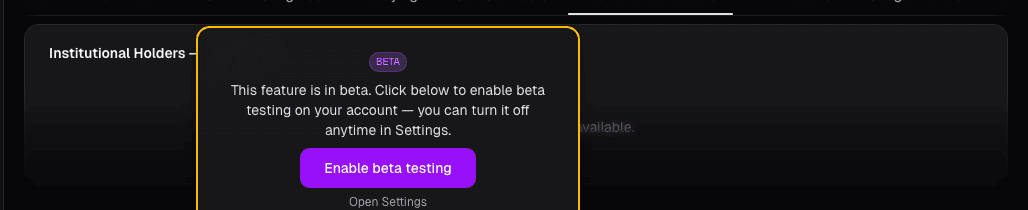
The Institutional Holders table lists the top 25 13F filers on this ticker:
- Fund name and classification: hedge fund / mutual fund / pension / insurance
- Shares held and dollar value at reporting period end
- Portfolio weight: % of the fund's reported AUM this position represents
- QoQ shares delta: new / add / trim / exit
- QoQ weight delta: the weight change, which is more meaningful than share change
- Trailing ownership history: 4-quarter share count trend for each filer
- Filter: largest holders vs. biggest QoQ increases: the latter is where new conviction shows up
- Hedge-fund flag: faster-turnover funds separated from slower mutual funds and pensions
Three reads
Sort by QoQ weight delta, not shares or dollars. A fund going from 0 to 2M shares is either a major new conviction or a routine index add, you can't tell from shares alone. But going from 0 to 3.5% of book is unambiguous conviction (a new concentrated allocation) while going from 0 to 0.2% of book is position initiation at starter size. The weight change tells you how the fund ranks this position inside its own book. Sorting by weight-delta surfaces the conviction moves that share-count sorting misses.
Cluster of independent adders > 2% of book = strong signal. Single large-fund additions are often just index-chasing or mean-reversion buys. Cluster of independent, concentrated long-biased funds each sizing the name at 2%+ of book in the same quarter is much rarer and much more informative. The three-funds-sizing-it pattern is the one I watch for, when it appears in a name that doesn't have a recent catalyst, it usually precedes one.
Exits of former conviction holders are firmer than entries. When a concentrated fund that had the name at 4% of book for 6+ quarters fully exits, something changed in the thesis. That's a stronger negative signal than the equivalent entry is a positive one, because entries can be starter positions that haven't been validated internally yet. Exits happen only after the internal review has concluded the thesis no longer works, so the information content is higher.
Example: the Q2 2023 industrial cluster
The three concentrated filings on the specialty industrial:
| Fund | Prior-quarter position | Q2 2023 position | Portfolio weight |
|---|---|---|---|
| Concentrated value fund A | 0 shares | 1.8M shares | 3.1% of book |
| Long-biased multi-strat fund B | 50k shares (0.1% weight) | 2.4M shares | 4.2% of book |
| Deep-value fund C | 0 shares | 980k shares | 2.5% of book |
Three independent funds, each with concentrated styles (top-10 positions usually account for 40%+ of AUM for these kinds of managers), each sizing this name at 2.5-4.2% of book in the same quarter. None had owned it before, and none were on the routine mid-cap-industrial 13F circuit. That's the signature of thesis-driven allocation rather than mechanical or indexing flow.
I took a 1/3 starter position in August, watched Q3 filings in November (two of the three held or added, one stayed flat), and added to full size. Position held for 14 months. The thesis that drove their conviction, a specific operational turnaround, played out across the next four quarterly prints.
What 13Fs can miss
- Non-US listings. 13F covers US equities only. Overseas listings don't appear.
- Short positions. Longs only, the full book is hidden.
- Derivatives-heavy positions. Options and swaps are partially disclosed at best; synthetic exposure is often missing.
- Confidential treatment delays. Some funds request delayed disclosure on specific names; those positions won't show up on the standard cycle.
- Pensions and non-US filers. Not all large institutional investors are 13F filers.
Common mistakes
- Sorting by dollar value only. A $500M position in a $20B fund is 2.5% of book; the same $500M in a $200B fund is 0.25% of book. Very different information.
- Chasing single-fund adders. One large fund adding is usually less informative than three concentrated ones clustering.
- Treating entries and exits symmetrically. Exits of former conviction positions are a firmer signal than entries.
- Assuming 13F data is timely. The filing is 45+ days lagged; don't trade on it as if it were current positioning.
- Ignoring fund style. A quantitative equity manager's 4% weight means something different from a concentrated value manager's 4% weight.
Where it fits
Pair with the Insider MSPR chart to check whether corporate insiders and external institutions are moving the same direction, divergences tend to resolve in favor of insiders on 6-month horizons. For fund-by-fund pattern work across many tickers, use the Investor Holdings card. Cross-reference with ETF Holdings for the passive-flow context, which can swamp active positioning in the near term.
FAQ
How long after quarter-end do filings land?
45 days maximum; most file in the 30-45 day window. The card updates as new filings arrive.
Are all 13F filers equal?
No. Sort by fund style: concentrated long-biased > multi-strat > pension > indexer for signal quality.
What about 13F-confidential treatment?
Some funds request delayed disclosure for specific names. The card flags when confidential-treatment filings are expected to unlock.
Can I follow a specific fund's book across its holdings?
Yes, the Investor Holdings card is the investor-first view.
Does the card handle ADRs and dual-listed names?
Yes, ADR holdings are aggregated with the primary US ticker.
Related reading
Open the Institutional Holders table → /app/stocks/AAPL/sentiment
See it in the app
Live dashboard views that match this post. Each tile deep-links to the exact card.
Stocks mentioned
Related reading
Congressional Trades on a Single Stock
The 'Congress outperforms the market' story hides where the actual signal is. It's not aggregate Congressional portfolios, it's a single committee chair's…
Corporate Lobbying Disclosures
Lobbying spend publicly discloses which regulatory fights a company is fighting. A quarter-over-quarter jump in contacts to a new agency often precedes the…
Dark Pool Activity: Reading the Institutional Order Flow
What dark pools are, why institutions use them, and how tracking dark pool prints and volume can reveal where smart money is positioning before it shows up…
Dark Pool Prints
Off-exchange share above 45% clustered into weakness signals institutional accumulation. Dark pool prints are regulated, post-trade transparent, and measurable.
How to Read 13F Filings Without Falling Asleep
A plain-language guide to understanding 13F filings, what they reveal about institutional investors, and how to use Alphactor's 13F explorer to spot…
Investor Diff: Turning Quarterly 13Fs Into Signal
A 13F snapshot is a photograph; the diff is the motion picture. Knowing what Klarman or Marks held last quarter is weakly useful, knowing what they added…
Ready to try alphactor.ai?
Validate your trading strategies with statistical credibility testing. Start free.
Get Started Free