When to Rebalance Your Portfolio
A quarterly review with a 3-5 point drift threshold captures most rebalancing benefit while avoiding unnecessary trading, avoids paying costs in calm markets.
 Marcus Chen4 min read
The Point of Rebalancing
Over time, a portfolio drifts. A position that started at 5% grows to 9%. A sector allocation that was 20% becomes 30%. Left unchecked, the portfolio that matched your risk tolerance six months ago no longer does. Rebalancing brings it back into alignment.
But rebalancing is not free. Every trade triggers transaction costs. In taxable accounts, selling winners generates capital gains. Rebalancing too frequently erodes returns through friction. Rebalancing too infrequently lets risk accumulate silently. The skill is finding the middle ground.
Calendar-Based vs. Threshold-Based
There are two primary approaches, and most institutional investors use a hybrid.
Calendar-based rebalancing means you rebalance on a fixed schedule: monthly, quarterly, or annually. The advantage is simplicity. You check your allocations on the first of the quarter, make adjustments, and move on. Academic research suggests quarterly rebalancing captures most of the benefit without excessive trading. Annual works too, but allows larger drift in volatile years.
Threshold-based rebalancing means you rebalance only when a position or sector deviates from its target by a set amount, typically 5 percentage points. A target allocation of 15% triggers rebalancing when the position drifts below 10% or above 20%. The advantage is that you only trade when drift is meaningful. In calm markets, you might not trade for months. In volatile markets, you trade more often, which is when rebalancing adds the most value.
The hybrid approach combines both: check on a quarterly schedule, but only rebalance positions that have drifted beyond a 3-5 percentage point threshold. This avoids unnecessary trading while maintaining disciplined oversight.
When Rebalancing Helps Most
Rebalancing is not equally valuable in all environments. It adds the most value in two scenarios.
Mean-reverting markets. When assets oscillate around a central tendency, selling what has gone up and buying what has gone down captures a systematic return. From 2000 to 2010, a simple 60/40 stock-bond portfolio that rebalanced annually outperformed an identical portfolio that never rebalanced by roughly 0.5% per year, because stocks and bonds alternated between strong and weak periods.
Volatile sideways markets. When markets chop without a clear trend, rebalancing harvests volatility. You are systematically buying low and selling high across your holdings.
Rebalancing adds less value, and can even hurt, in strong trending markets. If equities go straight up for three years, rebalancing forces you to sell equities and buy bonds repeatedly, leaving money on the table. The 2012-2019 bull market was a period where light rebalancing outperformed aggressive rebalancing.
When to Leave It Alone
Not every drift needs correction. Here are situations where the right move is patience.
Small drift in a trending market. If your 60% equity allocation has grown to 63% during a broad market advance, rebalancing into a 3-point drift costs you transaction fees and taxes without meaningfully changing your risk profile. Wait for a larger deviation.
Year-end tax considerations. In November, think twice before rebalancing by selling winners. Waiting until January pushes the tax liability into the next year. If a position is close to the long-term capital gains threshold (held less than 12 months), waiting a few weeks can cut your tax rate nearly in half.
Single-stock concentration from appreciation. If one stock has grown from 5% to 10% because the thesis is playing out exactly as expected, mechanically cutting it back to 5% penalizes success. Consider a wider band for high-conviction positions, perhaps allowing up to 8% before trimming, rather than rigidly snapping back to target.
A Practical Rebalancing Framework
Here is the framework I use with clients, adapted for self-directed portfolios:
Review frequency: Quarterly. Set a calendar reminder. Do not check more often unless there has been a major market event (a 10%+ drawdown qualifies).
Rebalancing thresholds:
- Individual positions: rebalance if more than 3 percentage points from target
- Sector allocations: rebalance if more than 5 percentage points from target
- Asset class splits (equity vs. fixed income): rebalance if more than 7 percentage points from target
Priority order: Rebalance the largest deviations first. If three positions need trimming and two need adding, start with the biggest mismatch.
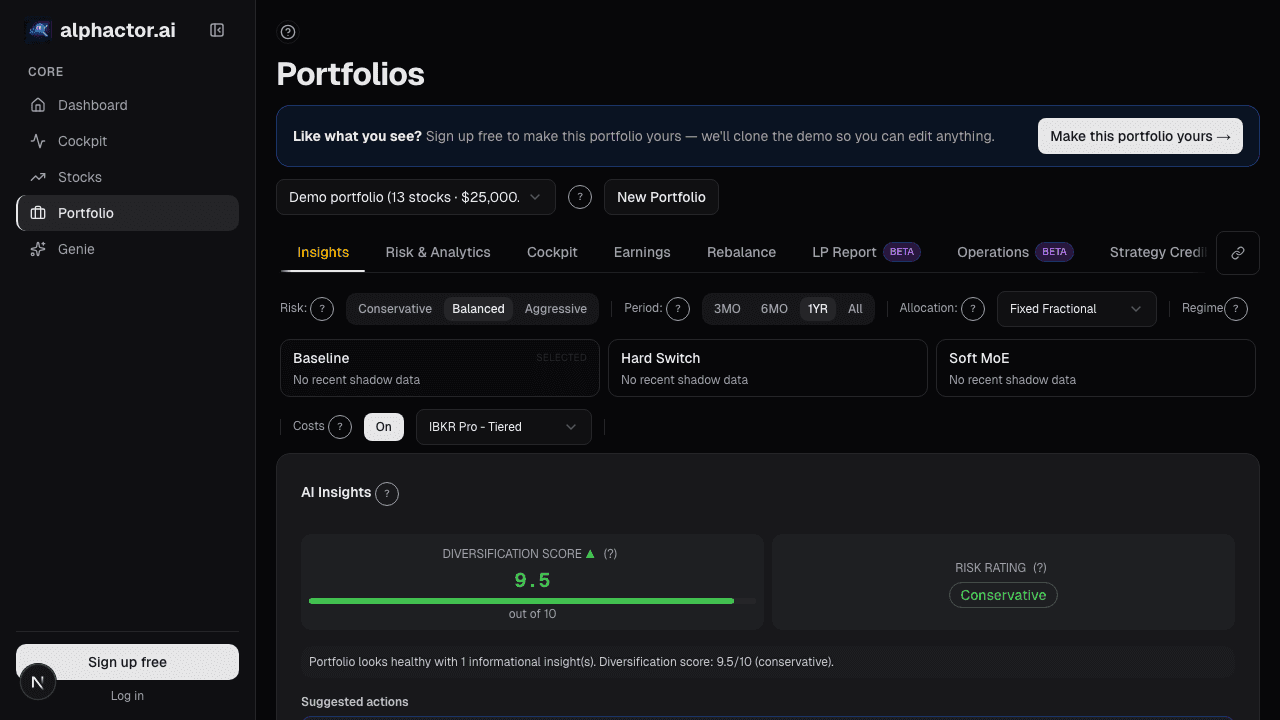
Tax-aware execution: In taxable accounts, prefer rebalancing by directing new cash (deposits, dividends) toward underweight positions rather than selling overweight ones. This achieves rebalancing without triggering capital gains. Alphactor's portfolio dashboard can flag the most tax-efficient rebalancing path given your current holdings and target weights.
The Cost of Not Rebalancing
The real risk of ignoring rebalancing is not a suboptimal return. It is an unintended risk profile. A portfolio that started as moderate-risk in January 2020 and was never rebalanced through the subsequent rally became an aggressive-risk portfolio by late 2021, right before the 2022 drawdown. Rebalancing would not have prevented the loss, but it would have reduced the magnitude.
Rebalancing is not about maximizing returns. It is about keeping your portfolio aligned with the level of risk you actually signed up for. That distinction matters more than any optimization.
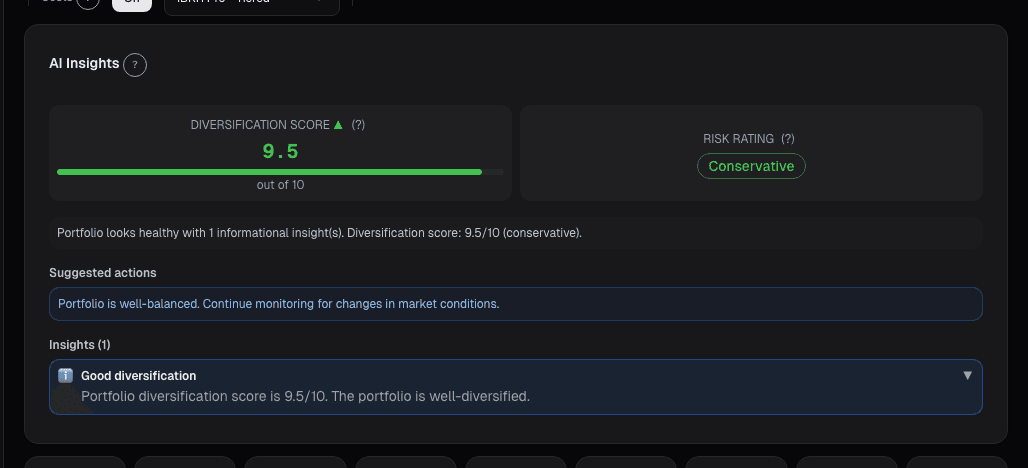
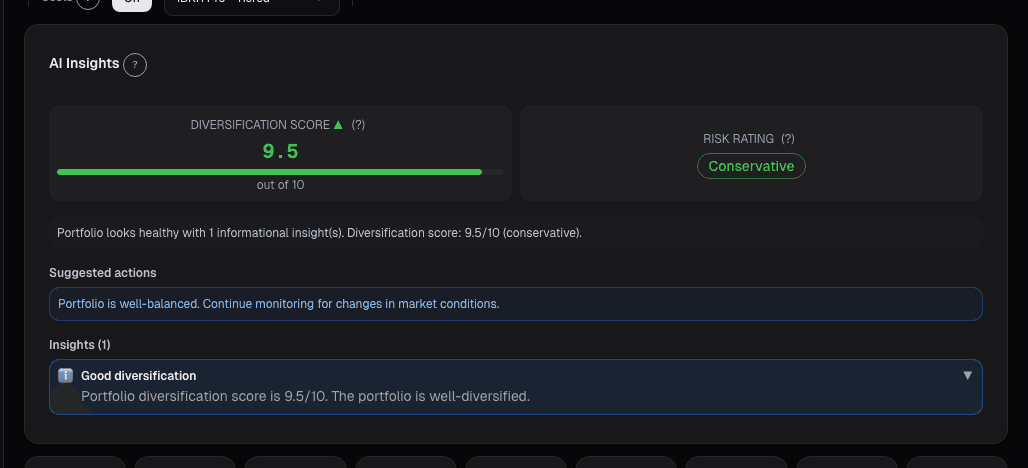
See it in the app
Live dashboard views that match this post. Each tile deep-links to the exact card.
Related reading
Choosing the Right Benchmark (Hint
Why benchmarking against the wrong index distorts your performance assessment and how to select a benchmark that matches your actual portfolio.
Factor Investing in Plain English
Value, momentum, quality, size, and volatility: the five major investment factors explained without jargon, with practical applications for retail portfolios.
Alt-Data Sentiment at the Portfolio Level
Per-ticker alt-data breaks down past 10 positions. A roll-up of WSB, news, MSPR, and options lets a 90-second scan replace 100 minutes of manual checking.
Risk Management for Retail Portfolios
Practical position sizing, stop-loss strategies, correlation awareness, and drawdown limits for retail investors managing their own money.
Portfolio Strategy When You Have Under $25K
Standard diversification assumes $100k or more. Under $25k means $750 per position across 20 stocks: a playbook that accounts for transaction cost drag.
Ready to try alphactor.ai?
Validate your trading strategies with statistical credibility testing. Start free.
Get Started Free