Portfolio Strategy When You Have Under $25K
Standard diversification assumes $100k or more. Under $25k means $750 per position across 20 stocks: a playbook that accounts for transaction cost drag.
 Marcus Chen4 min read
Small Accounts Have Different Rules
Most portfolio advice is written for people with $100,000 or more. The standard guidance (diversify across 20-30 stocks, allocate to multiple asset classes, maintain sector balance) assumes enough capital to size positions meaningfully. When you have $10,000 or $20,000, that math does not work. Twenty positions in a $15,000 portfolio means $750 each. At that size, transaction costs matter more, position management becomes tedious, and you cannot build meaningful exposure to any single thesis.
A small portfolio requires a different playbook. Not a worse one, just a different one that acknowledges the constraints of limited capital while preserving the principles that matter at any scale.
Constraint 1: Position Count
With under $25,000, holding more than 10-12 individual stocks creates more problems than it solves. Each position is too small to move the needle, and you spread your research attention too thin.
A more practical structure:
$5,000-$10,000: Hold 3-5 individual stocks and 1-2 broad ETFs. The ETFs provide diversification that individual picks at this size cannot. A single total market ETF plus 3 stock picks gives you market exposure and active upside.
$10,000-$15,000: Hold 5-8 individual stocks. Each position is $1,250-$3,000, large enough to matter. Supplement with one ETF for the portion of the market your picks do not cover.
$15,000-$25,000: Hold 8-12 individual stocks at $1,500-$3,000 each. This approaches the minimum viable portfolio for genuine stock picking. You can cover 4-5 sectors and maintain reasonable diversification.
Constraint 2: Transaction Costs Are Proportionally Higher
Most brokerages now offer commission-free trading on stocks and ETFs, which removed the biggest historical barrier for small accounts. But hidden costs remain.
Bid-ask spreads. On less liquid stocks, the spread can be 0.5-1%. On a $1,000 position, that is $5-$10 lost on the round trip. Multiply by 10 positions and you have consumed 0.5% of your portfolio before any thesis plays out. Stick to liquid names with tight spreads.
Fractional share limitations. Not all brokerages offer fractional shares on all securities. If a stock trades at $800 and your position budget is $1,500, you can buy 1 share, leaving $700 undeployed or forcing you to oversize.
Tax complexity. Selling a $2,000 position for a $300 gain generates tax liability that is barely worth the record-keeping. In small accounts, favor longer holding periods to reach long-term capital gains rates.
The ETF Core, Stock Satellite Approach
The most efficient structure for small portfolios is what institutional investors call "core-satellite." Put 40-60% of the portfolio into broad, low-cost ETFs. Use the remaining 40-60% for individual stock picks.
The core (40-60% of portfolio): One or two broad market ETFs. A total U.S. stock market ETF (VTI) or an S&P 500 ETF (VOO) covers the base. If you want international exposure, add a total international ETF (VXUS) at 20-30% of the core. This gives you instant diversification across hundreds of companies for a fraction of the cost of buying them individually.
The satellite (40-60% of portfolio): Your individual stock picks. These are where you express your research and conviction. Size them at 5-10% each. A $20,000 portfolio might have $10,000 in VTI and $10,000 spread across 5 stocks at $2,000 each.
This approach gives you the diversification of indexing with the upside potential of stock picking, without requiring enough capital to build a 25-stock portfolio from scratch.
What to Avoid With Small Capital
Avoid over-diversifying into tiny positions. Owning 25 stocks at $600 each is a self-managed index fund with higher costs and more work than buying an actual index fund. Hold enough of each stock to matter.
Avoid options strategies. Options on a $1,500 position create disproportionate risk. A covered call on 100 shares of a $15 stock ties up your entire position for marginal premium income. Options become practical above $50,000.
Avoid leveraged or inverse ETFs. These products decay in value over time due to daily rebalancing. In a small account where every dollar matters, the drag is especially harmful.
Avoid frequent trading. Small accounts cannot absorb the friction of frequent turnover. Aim for quarterly rebalancing at most, with an average holding period of six months or longer.
Growing the Account
The single most impactful thing you can do with a small portfolio is add to it consistently. Adding $500 per month to a $15,000 portfolio is a 3.3% monthly capital injection. At that rate of contribution, the additions will drive more growth than investment returns for the first several years. Direct new capital toward your most underweight positions to rebalance without selling.
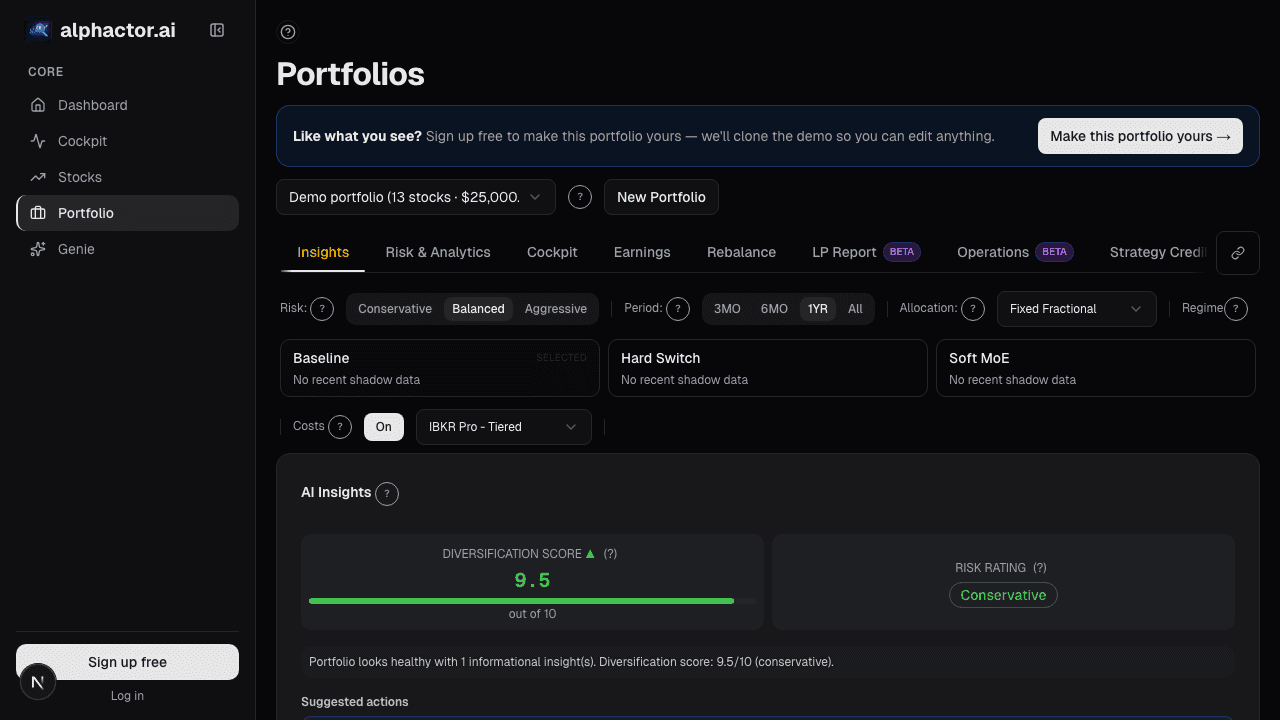
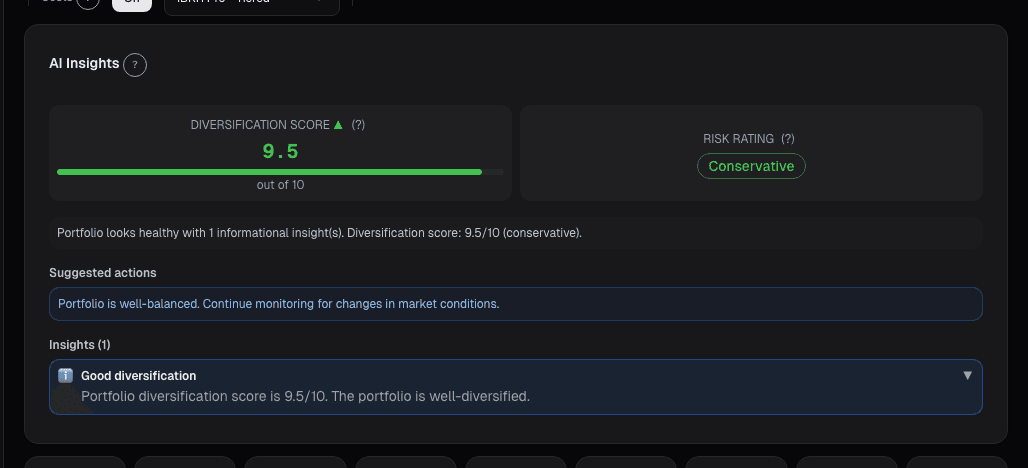
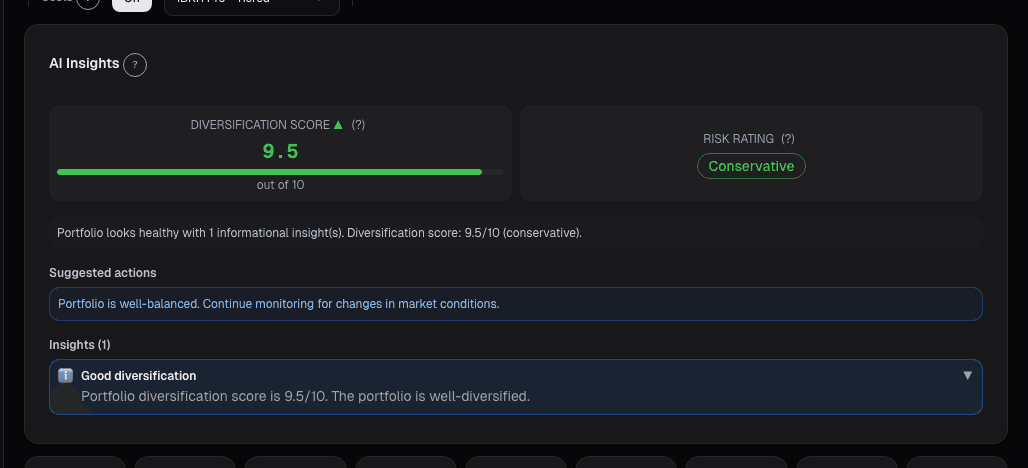
As the portfolio grows past $25,000, gradually shift from the core-satellite structure toward a fuller individual stock portfolio. Add positions one at a time as capital allows, using Alphactor's portfolio dashboard to identify where new positions would reduce portfolio-level risk through diversification. The universe scanner can surface candidates that complement your existing holdings.
The Mindset Shift
A small portfolio is not a handicap. It is a laboratory. Every mistake costs less in absolute dollars. Every lesson is cheaper to learn. You can also use paper trading to test ideas without risking real capital while you build your account. The investor who builds disciplined habits managing $15,000 is far better prepared for $150,000 than the one who waits until they have a large account to start thinking about portfolio construction.
See it in the app
Live dashboard views that match this post. Each tile deep-links to the exact card.
Related reading
Choosing the Right Benchmark (Hint
Why benchmarking against the wrong index distorts your performance assessment and how to select a benchmark that matches your actual portfolio.
Factor Investing in Plain English
Value, momentum, quality, size, and volatility: the five major investment factors explained without jargon, with practical applications for retail portfolios.
Alt-Data Sentiment at the Portfolio Level
Per-ticker alt-data breaks down past 10 positions. A roll-up of WSB, news, MSPR, and options lets a 90-second scan replace 100 minutes of manual checking.
When to Rebalance Your Portfolio
A quarterly review with a 3-5 point drift threshold captures most rebalancing benefit while avoiding unnecessary trading, avoids paying costs in calm markets.
Risk Management for Retail Portfolios
Practical position sizing, stop-loss strategies, correlation awareness, and drawdown limits for retail investors managing their own money.
Ready to try alphactor.ai?
Validate your trading strategies with statistical credibility testing. Start free.
Get Started Free