Part of: Risk Management
ATR for Position Sizing
How Average True Range normalizes risk across stocks, sets intelligent stop losses, and determines position size based on volatility, not gut feeling.
 Jake Morrison5 min read
TL;DR
- ATR converts position sizing from a fixed-dollar guess into a volatility-adjusted risk budget.
- The stop distance should be a multiple of ATR, not an arbitrary 5% or 10% rule.
- High-volatility stocks get smaller share counts, while low-volatility stocks can carry more notional exposure for the same dollar risk.
- ATR also helps identify volatility regimes, which should influence stop multiples and trade frequency.
The Problem With Fixed Dollar Stops
Most retail traders size positions by dollar amount and set stops by percentage. "I will buy $5,000 of each stock and use a 10% stop loss." Sounds disciplined. It is not.
A 10% stop on JNJ, which moves about 0.8% per day, gives the position enormous room relative to normal volatility. That same 10% stop on SMCI, which routinely moves 5-7% per day, is a single bad afternoon away from triggering.
The JNJ position will almost never hit the stop, meaning the stop provides no real risk management. The SMCI position will hit the stop constantly on normal noise, turning you into a serial loss-taker.
Same dollar amount, same percentage stop, completely different risk profiles. ATR fixes this.
What ATR Measures
Average True Range calculates the average daily price range over a lookback period, typically 14 days. "True range" accounts for gaps by including the distance from the prior close to the current high or low, whichever is greater.
As of early 2025, here are some representative 14-day ATR values:
- JNJ: $1.90 (about 1.2% of price)
- AAPL: $4.50 (about 2.0% of price)
- NVDA: $9.80 (about 7.5% of price)
- SMCI: $38.00 (about 6.0% of price)
These numbers tell you what the market considers a normal daily move for each stock. Your stop loss and position size should be calibrated to this reality, not to an arbitrary percentage.
ATR-Based Stop Losses
The standard approach: set your stop at a multiple of ATR from your entry price.
2x ATR is the most common choice for swing trades. If you buy AAPL at $225 with a 14-day ATR of $4.50, your stop goes at $225 - (2 x $4.50) = $216. That is $9 below your entry, or about 4%. It gives the position room to breathe through two normal days of adverse movement.
1.5x ATR works for tighter, momentum-based trades where you want to get out quickly if the thesis breaks. Higher hit rate on the stop, but the stops that do not trigger tend to capture faster moves.
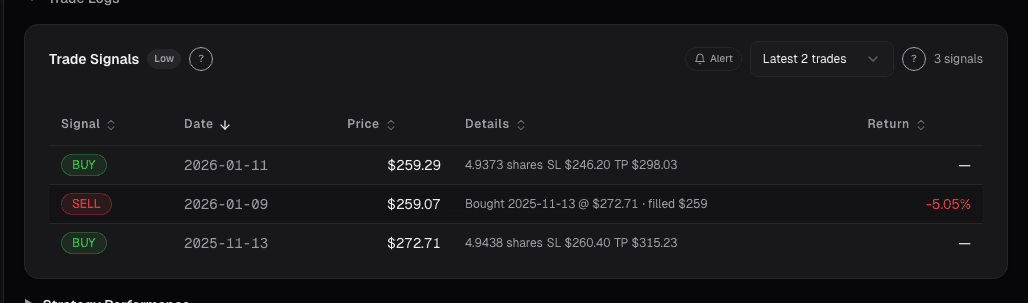
3x ATR is for longer-term position trades where you want to ride through normal volatility and only exit on genuine trend changes. The tradeoff is larger individual losses when the stop hits.
The critical advantage: these stops automatically adjust to the stock's volatility. A 2x ATR stop on JNJ is about 2.4% from entry. On NVDA it is about 15%. Each stop is proportional to that stock's normal behavior.
Volatility-Normalized Position Sizing
Here is where ATR becomes a complete risk management tool. The formula is straightforward:
Position Size = Risk Per Trade / (ATR Multiple x ATR)
Say you have a $100,000 portfolio and you risk 1% per trade, which is $1,000.
For AAPL (ATR $4.50, 2x ATR stop = $9.00):
$1,000 / $9.00 = 111 shares, roughly $25,000 notional.
For NVDA (ATR $9.80, 2x ATR stop = $19.60):
$1,000 / $19.60 = 51 shares, roughly $6,600 notional.
For JNJ (ATR $1.90, 2x ATR stop = $3.80):
$1,000 / $3.80 = 263 shares, roughly $41,000 notional.
Notice what happened. You are taking a larger position in the low-volatility stock and a smaller one in the high-volatility stock. But your dollar risk is identical: $1,000 per trade across all three. Each position contributes equally to your portfolio risk.
This is the fundamental insight. You are not equalizing dollar exposure. You are equalizing risk.
The Risk Budget Framework
Professional desks think in terms of risk budgets, not dollar budgets. A portfolio that risks 1% per trade can hold 10-15 positions before aggregate risk becomes uncomfortable. If each position can lose $1,000 at the stop and you have 12 positions, your maximum single-day loss if everything goes wrong simultaneously is $12,000, or 12%.
In practice, positions are not perfectly correlated, so actual worst-case scenarios are less severe. But the framework forces you to think about portfolio-level risk before adding a new position.

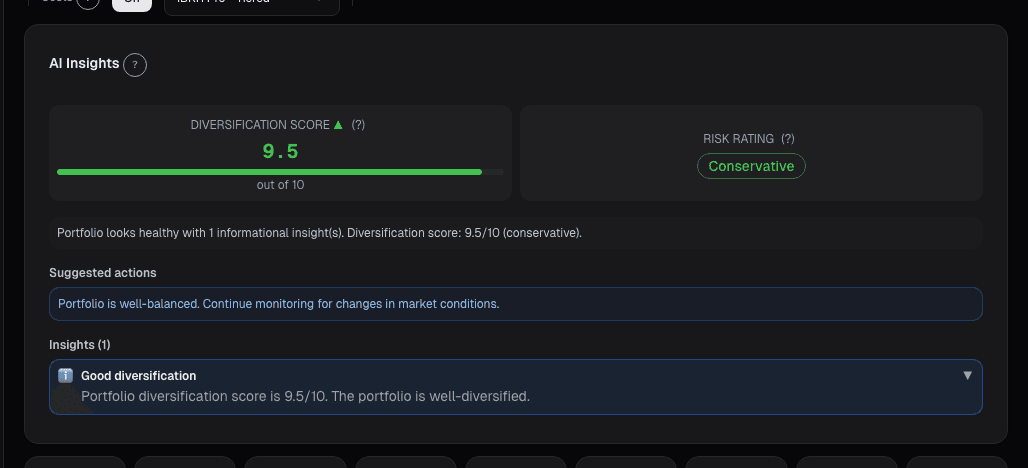
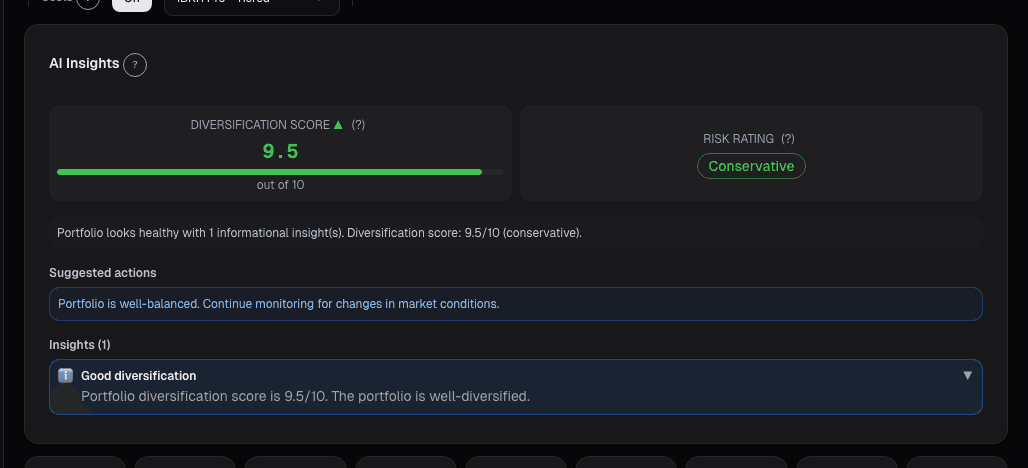
Before entering a new trade, ask: "If I add this position at the ATR-calculated size, what is my total portfolio risk?" If you are already at 10-12 open positions, adding another means either passing on the trade or closing something. A portfolio dashboard that tracks aggregate exposure makes this check fast.
ATR as a Volatility Regime Indicator
ATR is not just for position sizing. It tells you about the market's current state.
When ATR is expanding, the market is becoming more volatile. Tighten your multiples (1.5x instead of 2x) because the baseline is already elevated.
When ATR is contracting, the market is quieting down, often preceding a breakout. You can use wider multiples (2.5-3x) because the range is compressed.
Watching ATR on SPY or QQQ gives you a read on the overall market's volatility regime, which should influence how aggressively you trade individual names.
A Non-Negotiable Habit
Every trade should have an ATR-based stop calculated before entry. Not after. Not "approximately." Write down the ATR, the multiple, the stop price, and the resulting position size. The fundamentals view displays current ATR alongside price data, making this calculation a 15-second exercise rather than a reason to skip it.
The traders who survive long enough to compound are almost always the ones who sized their positions based on volatility, not conviction. Conviction determines whether you take the trade. ATR determines how much.
FAQ
What ATR multiple should I use for a swing trade?
I usually start with 2x ATR because it gives a position room to absorb normal noise without making the stop meaningless. Tighter momentum trades may use 1.5x, while longer holding periods often need 2.5x to 3x.
Should ATR position sizing replace portfolio limits?
No. ATR equalizes per-trade risk, but it does not solve correlation, sector concentration, or total exposure. I still check aggregate portfolio risk before adding another ATR-sized position.
Does ATR predict direction?
No. ATR measures range, not trend. It tells you how much a stock normally moves, which is useful for sizing and stops, but it does not say whether the next move is up or down.
How often should I recalculate ATR?
Recalculate before every new trade and whenever volatility changes materially. If ATR expands sharply after entry, the position may now represent more risk than your original budget allowed.
Related posts
See it in the app
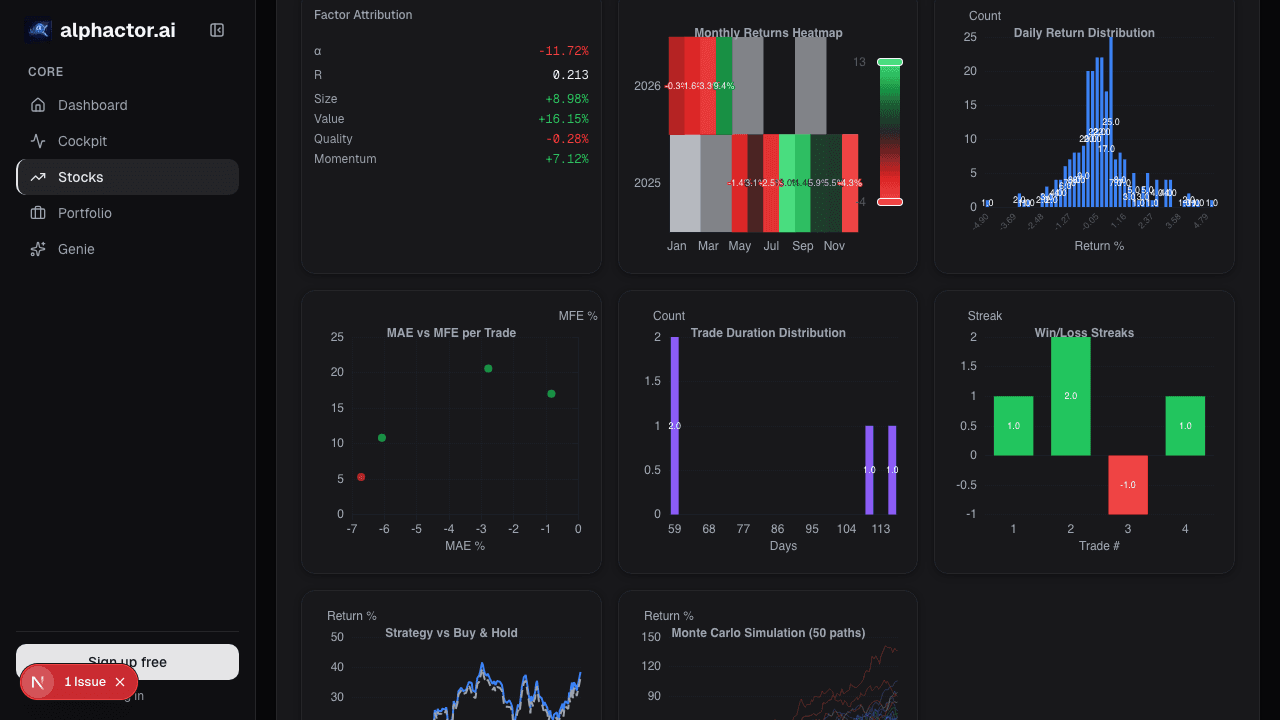
Live dashboard views that match this post. Each tile deep-links to the exact card.
Stocks mentioned
Related reading
ADX: How to Measure Whether a Trend Is Worth Trading
ADX measures trend strength, not direction. Here is how to use it with directional indicators to identify trending markets and avoid costly whipsaws in ranges.
Half-Kelly Position Sizing
Half-Kelly gives about three-quarters of full Kelly growth while cutting drawdown by roughly 50%, making a theoretically optimal bet practically executable.
Market Breadth: The Health Check Most Investors Skip
How advance-decline lines, new highs-lows, and participation rates reveal whether a rally is built on solid ground or propped up by a handful of stocks.
A Position Sizing Framework That Won't Keep You Up at Night
A practical position sizing approach built on simplified Kelly criterion, risk-per-trade limits, and portfolio-level allocation guardrails.
The 5 Position Sizing Mistakes That Blow Up Accounts
Position sizing errors kill more accounts than bad stock picks. Here are the five most common mistakes and how to avoid each one.
Ready to try alphactor.ai?
Validate your trading strategies with statistical credibility testing. Start free.
Get Started Free