Most people who blow up a trading account do not blow it up on a single bad trade. They bleed to death over thirty trades because they never wrote down how much they were willing to lose per trade, per week, per month, or per regime shift. Risk management is the set of pre-committed rules that decides those numbers for you before the market tempts you to change them. This pillar is the one I would teach to a friend the day before they open their first margin account, and it is the one I personally check against every Friday evening with a coffee and a spreadsheet.
What "risk" actually means here
Risk is not volatility. Volatility is how much a price wiggles; risk is how much *my account* can permanently lose because of those wiggles. Those are different numbers because my own decisions, my sizing, my stop rules, my leverage, my correlation exposure, sit between the market's volatility and my realized loss. A 3% daily standard-deviation ticker in a 1% position is a bored asset on my screen. The same ticker at 40% of the book is a career risk.
That framing matters because it tells you where the levers are:
- Position size: the single biggest lever. Halve the position, halve the risk, exactly.
- Stop placement: the second biggest lever. A wider stop multiplies dollar risk linearly.
- Correlation: the silent killer. Three uncorrelated 1% bets are not three correlated 1% bets; the latter is one 3% bet pretending to be diversified.
- Leverage: a multiplier on all three of the above.
Everything in this pillar comes back to those four levers. If you can name which lever you are pulling on any given trade, you are already ahead of 80% of retail.
The fixed-fractional rule, and why 1% is not magic
The default I come back to is the fixed-fractional rule: risk a fixed fraction of current account equity on every trade. The textbook number is 1%. It is not magic. It is a number that makes the math tractable: with a 1% risk-per-trade rule, you need ~10 consecutive full losses to draw down ~10%, and a losing streak that long on an even mildly edge-positive system is rare enough that you can keep making decisions calmly.
Concretely: if my account is \$50,000, 1% is \$500. That is the total dollar amount I am willing to lose if the trade hits its stop. If my entry is \$100 and my stop is \$95, my per-share risk is \$5, so I buy 100 shares. If my entry is \$100 and my stop is \$90, per-share risk is \$10, and I buy 50 shares. Same dollar risk either way. The stop decides the size. Not the other way around.
Common ways I see people break this rule:
- Sizing first, stopping second. They pick a "round number" like 100 shares, then decide the stop. Now the stop is a rationalization instead of a decision.
- "Mental stops." Unwritten stops are marketing copy for the version of you that wants to hold losers. Put the stop in the book.
- Re-basing after a big win. Winning streaks make people feel smart and they start risking 2-3% to "press the edge." This is how you give back a quarter in a week.
If 1% feels small, that's the point. It means you can be wrong twenty times in a row and still be in the game.
Drawdown math is unforgiving
The reason risk rules are non-negotiable is the asymmetry of recovery. If you lose 10%, you need to make ~11% to get back. If you lose 20%, you need ~25%. At 50% down you need to double. At 75% down you need to quadruple. The curve is convex in a way that punishes big losses disproportionately. Two 10% drawdowns in a row (compound ~-19%) are enormously cheaper than a single 30% drawdown, even though they "feel" similar in the moment.
This is why I cap rolling drawdown, not just per-trade loss. My personal rule: if my account is down 8% from its peak, I cut risk-per-trade in half (0.5%) until I'm back within 3% of the peak. If I'm down 15%, I stop putting on new trades entirely and I spend a week reviewing what went wrong. I have never regretted this rule. I have regretted every time I got cute and broke it.
A checklist I keep on my desk:
- What's my current equity?
- What's the equity peak of the last 60 days?
- What's the drawdown from peak?
- Based on that drawdown, what is my current risk-per-trade fraction?
- Am I actually using that fraction, or did I sneak in a bigger position?
Correlation: where "diversified" portfolios go to die
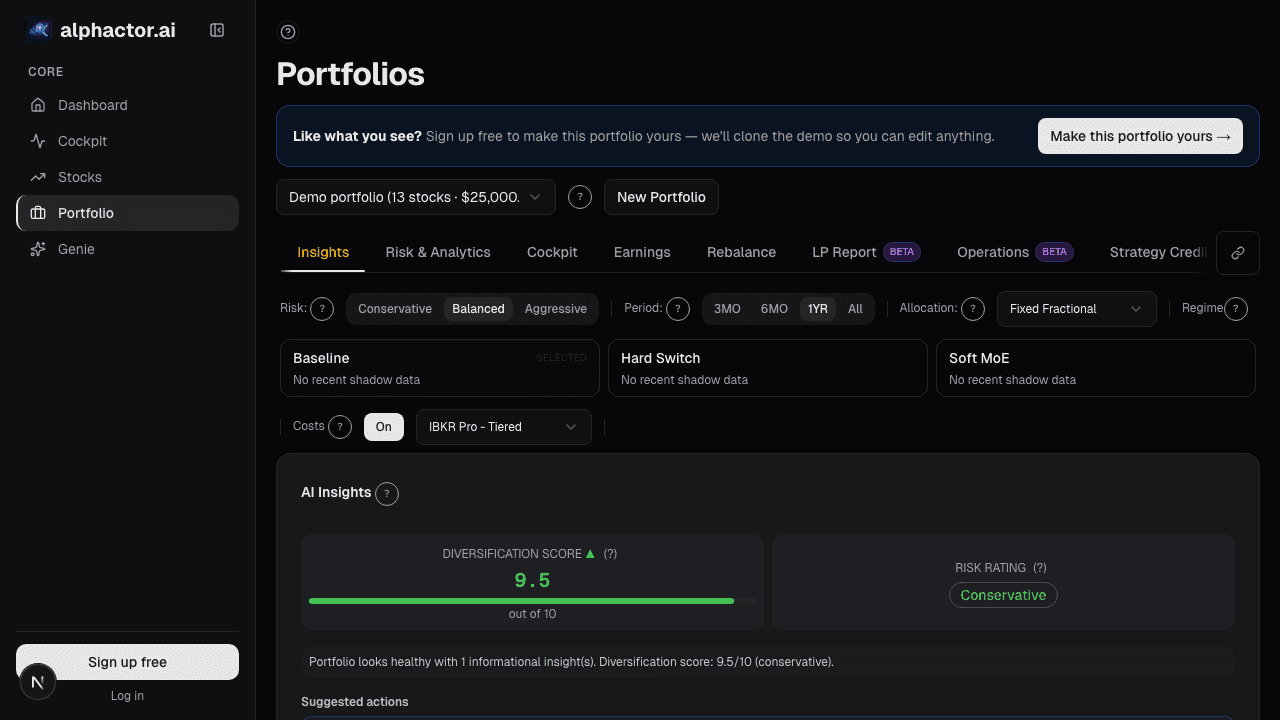
Owning ten tech names is not a diversified portfolio. It is one big bet on semiconductor capex and the Fed's tolerance for long-duration assets, broken into ten tickers so it feels better. The alphactor.ai Portfolio Correlation Matrix is the single view I look at every Monday morning, if my top-eigenvalue concentration is above ~0.6, I trim.
A few rules of thumb I use:
- Limit exposure to any single GICS sector to 30% of the book.
- Treat any pair of names with >0.8 trailing-3-month return correlation as one position. That usually catches the "NVDA and AMD" or "WTI and energy majors" pairs that retail tends to underweight in their diversification estimate.
- Add macro factor buckets. Long-duration growth, short-duration value, commodity-producers, defensives. When three of my four "diversified" positions are all long-duration growth, I'm running a concentrated bet whether I meant to or not.
Position-sizing variants worth knowing
Fixed-fractional is the starting point. As you get more sophisticated you can adopt:
- Volatility-targeted sizing. Instead of a fixed dollar risk, you scale each position so its contribution to portfolio volatility is equal across positions. Riskier assets get smaller sizes automatically. This is what most CTA funds do and it's a big improvement over flat-dollar sizing when you trade a mix of tickers.
- Kelly fractional. If you have reliable estimates of edge (win rate, win/loss ratio), the Kelly formula gives the growth-optimal bet size. Almost nobody has reliable estimates, so half-Kelly or quarter-Kelly is the realistic practice. Full Kelly is how pros blow up.
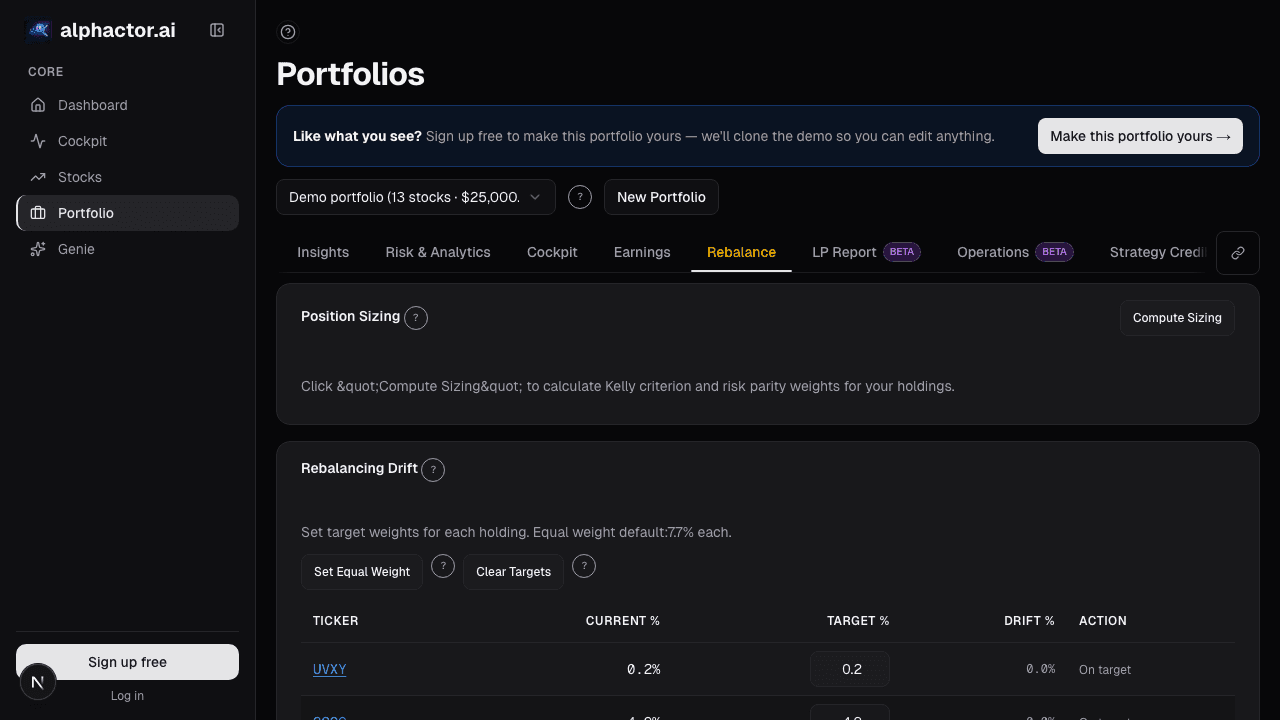
- Risk parity across the book. Allocate so that each position contributes equally to total portfolio standard deviation. Works beautifully in back-test, requires more re-balancing than retail usually wants to do.
All of these still need a hard cap layer on top. Volatility targeting tells you relative sizing; it doesn't prevent you from being 200% net long when the whole market is about to gap down. The 1% fixed-fractional rule is a floor; these are refinements above it.
Example: the March 2023 regional-bank trade
On 2023-03-09 SIVB (Silicon Valley Bank) was down ~60% intraday. A lot of retail bought the dip. I didn't, and the rule that stopped me was correlation, not a price signal: the same regime screen that flagged SIVB was lighting up PACW, WAL, FRC, KEY, and ZION. Buying SIVB there was not a single-bank bet; it was a bet that a deposit run would not spread. The Regime Signals dashboard had flipped the regional-banks cluster into "stress" and the macro regime was already "tightening/crisis-adjacent." The whole basket drew down another ~35% from there in three trading days. The thing that saved me was not brilliance. It was a rule: I don't initiate in a sector flagged stress while the macro regime is crisis-adjacent, regardless of how attractive the single name looks.
Common mistakes
- Using a stop wider than your edge justifies. A 15% stop on a mean-reversion system with 4% average trade range is noise-dominated. The stop rarely triggers *because* of the mean reversion, so you end up sized correctly for a thesis the system isn't actually testing.
- Not stopping out because "the fundamentals are still good." Fundamentals don't mark your P&L. The tape does. Stop out; re-enter if the setup returns.
- Scaling down winners to "take profits" but not scaling down losers. Asymmetric behavior by P&L status is the single biggest reason retail has right-skewed win rate and left-skewed dollar P&L.
- Ignoring overnight gap risk on single names. Option-implied overnight vol on biotech and small-cap tech is routinely 5–10%. A "tight" 3% stop is meaningless if you hold overnight through an FDA decision.
- Confusing stop-loss with risk management. Stops are one of four levers. You can run an account with no stops at all if position sizing, correlation caps, and leverage are tight enough, and you can blow up with stops on every position if the other three levers are loose.
FAQ
How small should my risk-per-trade be if I'm just starting out?
Start at 0.5%. You don't yet know your own variance, the distribution of your own outcomes, and you want enough trades in the sample before you commit real money at 1%. A 0.5% sizing rule means a 20-trade losing streak costs you ~10% of account. That buys you enough runway to learn your own system without blowing up.
Do I need a stop on every trade?
You need a pre-committed exit on every trade. That exit does not have to be a resting stop order. On a 5-year buy-and-hold position it might be "sell if the fundamentals deteriorate in a specific, defined way." On a swing trade it's a price stop, written down. On options it's a delta-based unwind or a time stop. The principle is: never enter without already knowing what makes you exit on the downside.
How do I size through a losing streak?
The fixed-fractional rule does this automatically, as equity falls, your dollar risk falls with it. On top of that, my personal drawdown brake kicks in at 8%. Other traders use a "trailing drawdown" rule: if drawdown from peak exceeds X%, halve size. The exact number matters less than having a pre-committed rule so you're not deciding mid-slump.
Is it okay to use leverage?
Leverage is a multiplier on all the risk you already have. If you're running 2× leverage, your 1% fixed-fractional is really 2% notional. It's only okay if you've done the math on that and you're comfortable with the resulting drawdown distribution. Most retail accounts run leverage because "the broker offered it," which is the worst reason.
How do I balance risk management with wanting to actually make money?
This is the real tension and I don't dismiss it. Ultra-tight risk rules can grind you to zero via fees and opportunity cost even if they never draw you down. The answer is to raise the *quality bar on what gets a position at all*, not to loosen the risk rules on the positions you take. Fewer trades, higher conviction, same sizing rule.