Part of: Technical Analysis
Your Trading Signals Have a Noise Problem
Why most trading signals fire too often to be useful, and how to filter with multiple timeframes, volume confirmation, and market regime awareness.
 Marcus Chen5 min read
200 Signals a Week, Maybe 3 Worth Taking
I built my first automated signal scanner in 2017. It checked for RSI oversold conditions, MACD crossovers, and moving average support touches across the S&P 500. The first week it ran, it flagged 214 stocks. I was thrilled. I had so many opportunities.
Six months and a smaller account later, I realized the problem. The signals were technically correct, RSI was below 30, MACD did cross, but most of them were garbage. Stocks triggering oversold in a bear market. MACD crosses in choppy consolidations that reversed immediately. Moving average touches on low-volume drift days that meant nothing.
My scanner had a noise problem. It was detecting everything and filtering nothing. And this is the trap most traders fall into, whether they use automated tools or scan charts manually. If your process generates more than 5-10 actionable signals per week in a universe of 500 stocks, you almost certainly have a signal quality problem.
Why Signals Fire Too Often
Most technical signals use a single condition on a single timeframe. RSI below 30. Price crossing the 50 SMA. MACD histogram turning positive. Each of these events happens frequently because markets are noisy. Random price movement triggers these thresholds constantly without any genuine shift in the supply-demand balance.
An RSI reading of 29 on a quiet Tuesday when volume is 40% below average and the stock just drifted lower in a mild pullback is not the same signal as RSI at 25 after a sharp three-day selloff on heavy volume into a major support zone. But a simple "RSI below 30" scanner treats them identically.
The fix is not a better single indicator. No individual indicator can distinguish meaningful moves from noise on its own. The fix is layering complementary filters that each capture a different dimension of signal quality.
Filter 1: Multiple Timeframe Alignment
The single most effective noise reduction method I have found is requiring signals to align across timeframes. A buy signal on the daily chart is significantly more reliable when the weekly chart confirms the trend direction.
My framework:
- Weekly chart sets the trend direction. Is price above the 40-week moving average? Is the weekly MACD above zero? If the answer is no, daily buy signals in that stock are low quality, no matter how good they look.
- Daily chart generates the actual signal. RSI oversold, moving average support touch, bullish candlestick pattern, whatever your setup is.
- 4-hour or 60-minute chart refines timing. Once the daily signal fires and the weekly confirms, drop to an intraday chart for precise entry.
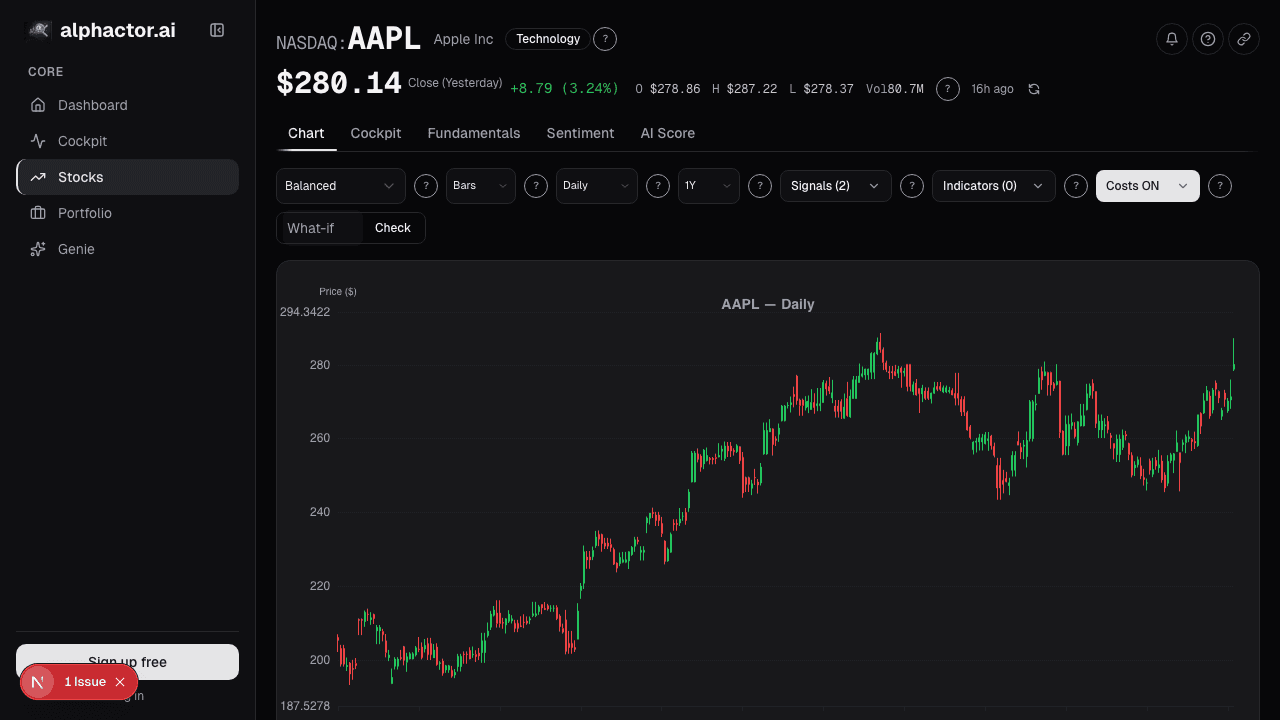
This alone eliminates about 60% of false signals. All those RSI oversold readings in bear trends? Filtered out because the weekly chart shows a downtrend. The daily MACD crosses in choppy markets? Many get filtered because the weekly trend is unclear.
Filter 2: Volume Confirmation
Volume is the lie detector of technical analysis. Price can move on thin air, a few market orders can push a stock through a level on a low-volume day. But when a signal fires alongside volume that is 1.5-2x the 20-day average, real participants are involved.
I require above-average volume on the signal day for any trade I take. Not estimated volume or projected volume, actual completed volume. This means I often enter the day after the signal, which bothers some traders who want to catch the exact reversal candle. I gave up catching exact bottoms a long time ago. I would rather enter slightly late with volume confirmation than early without it.
For breakout signals specifically, I use a higher threshold: 2x average volume minimum. Breakouts on average or below-average volume fail at a rate that makes them essentially untradeable. I tracked this across 150 breakout trades in 2021-2022 and the data was clear: above-2x-volume breakouts had a 62% continuation rate versus 38% for below-average-volume breakouts.
Filter 3: Market Regime Awareness
This is the filter that most traders ignore entirely, and it is arguably the most important. The same signal has dramatically different win rates depending on the broader market environment.
A bullish RSI divergence in a calm, uptrending market (VIX below 18, SPY above its 50-day SMA) has strong historical follow-through. The same divergence in a volatile, downtrending market (VIX above 25, SPY below its 50-day SMA) is much less reliable because macro headwinds overwhelm individual stock signals.
I categorize market regimes into four buckets:
- Low volatility uptrend (VIX < 18, SPY > 50 SMA), Most bullish signals work. Full position sizes.
- High volatility uptrend (VIX > 18, SPY > 50 SMA), Bullish signals work but need tighter stops. Reduced position sizes.
- Low volatility downtrend (VIX < 18, SPY < 50 SMA), Selective signals only. Very few longs.
- High volatility downtrend (VIX > 25, SPY < 50 SMA), Almost nothing works on the long side. Cash or short only.
Just overlaying this regime filter onto my signal output cut false signals by another 30%. The regime analysis on Alphactor categorizes the current market environment, saving you from applying this filter manually.
Quality Over Quantity in Practice
After implementing all three filters, my scanner went from 200+ signals per week to about 5-8. My first reaction was panic, surely I was missing opportunities. But my win rate jumped from about 42% to 58%, and my average winner-to-loser ratio improved because I was entering higher-quality setups with better context.
The conviction scoring addresses this same problem computationally. The platform does not just flag when an indicator hits a threshold, it weighs the signal against trend context, momentum confirmation, and market conditions to produce a conviction score. High-conviction signals are the filtered output. Low-conviction signals are the noise that my manual process used to let through. When I backtest strategies on the platform, I see the same pattern: tightening the conviction threshold reduces signal frequency but improves the quality of what is left.
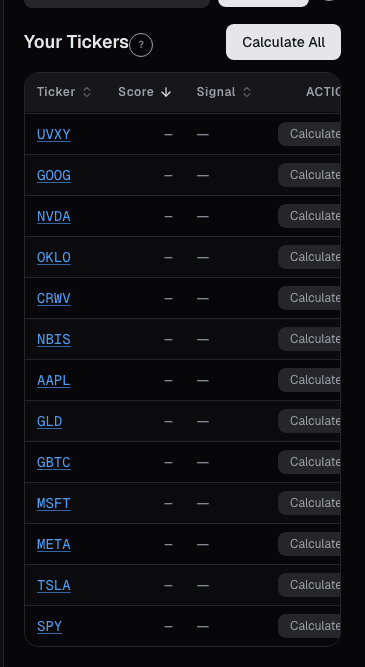
The hardest psychological shift in trading is accepting that fewer signals lead to better results. We are wired to think more opportunities means more profit. The opposite is true. Every bad signal you filter out is a loss you avoided. Every marginal setup you skip is capital preserved for the high-conviction trade that shows up three days later.
Your job is not to trade every signal. It is to wait for the signals that have earned your capital.
See it in the app
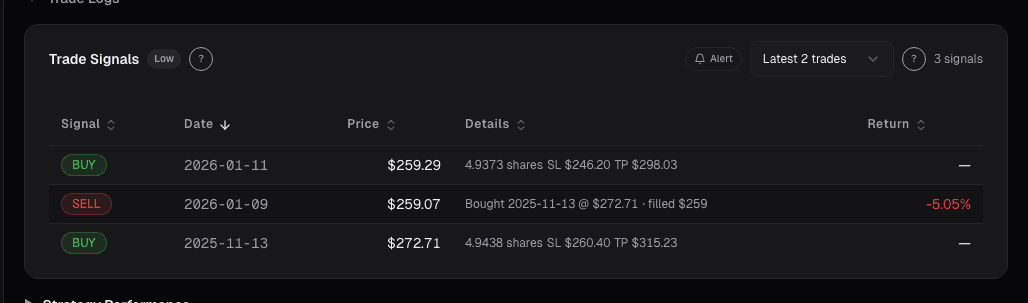
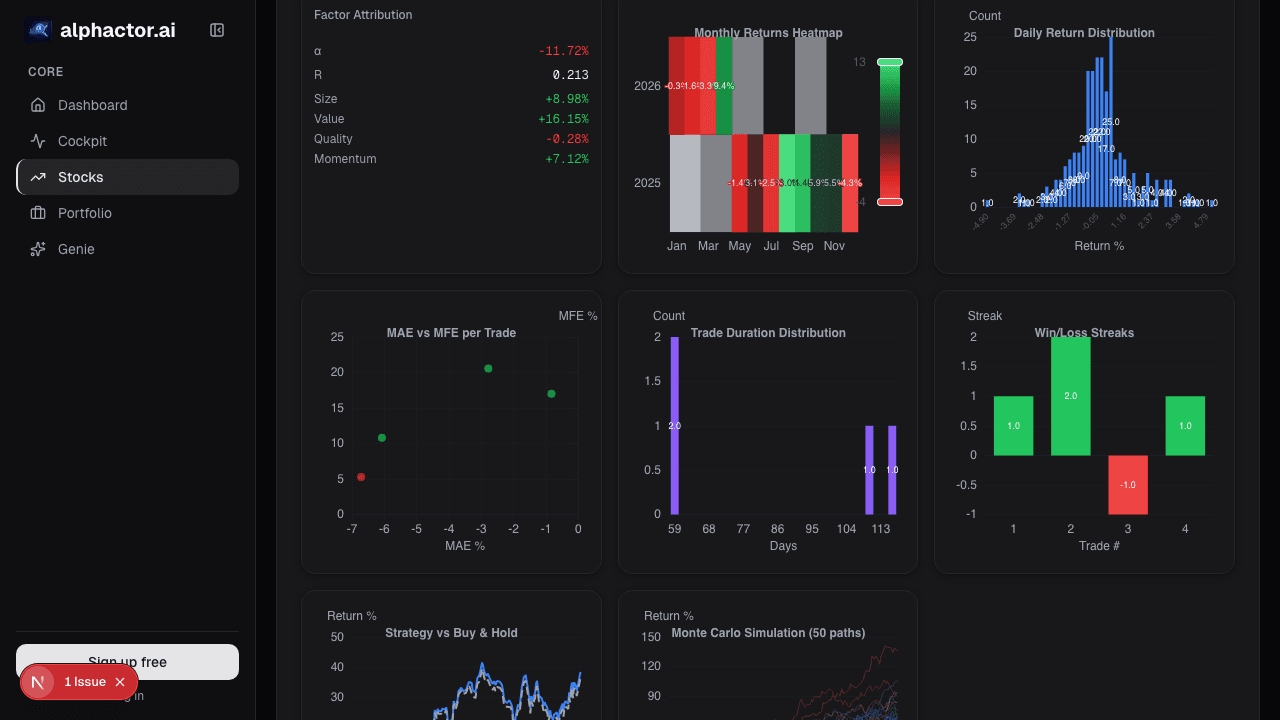
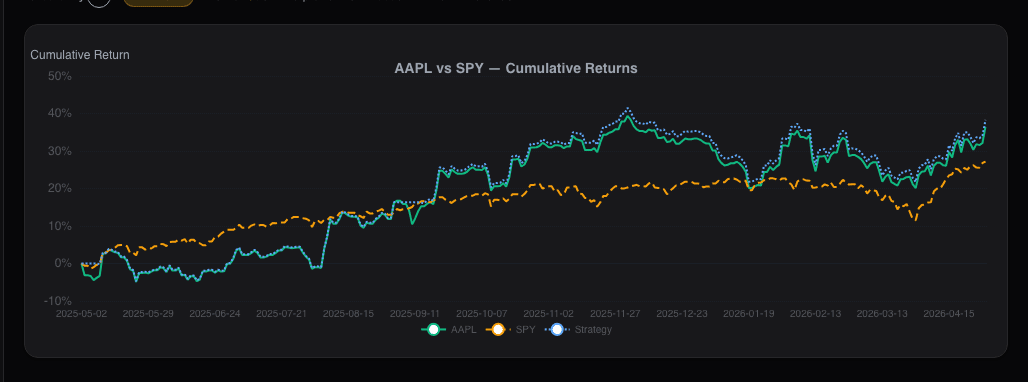
Live dashboard views that match this post. Each tile deep-links to the exact card.
Stocks mentioned
Related reading
Breakout Strategies
A systematic look at breakout trading across 500 stocks over 10 years, with real numbers on win rates, expectancy, and the filters that separate signal from…
How to Backtest a Trading Strategy (The Right Way)
Learn how to properly backtest trading strategies, avoid common pitfalls like overfitting, and use statistical credibility testing to validate your results.
Mean Reversion Signals: Buying the Dip With Math, Not Hope
How to use z-score, Bollinger %B, and RSI extremes as mean reversion triggers, and why the strategy only works in specific market conditions.
A Mean Reversion Strategy That Survived Walk-Forward
How a 2-period RSI mean reversion strategy on the S&P 500 held up across 15 years of walk-forward validation, and what the numbers actually look like.
Combining Multiple Signals Into One Strategy
How to merge momentum, value, and quality signals into a single composite score that survives walk-forward testing, with practical rules to avoid the…
Regime-Aware Strategy Selection
Markets cycle through trends, ranges, and shocks. Learn how regime detection drives which strategy runs, and why a mixture of experts beats a single static…
Ready to try alphactor.ai?
Validate your trading strategies with statistical credibility testing. Start free.
Get Started Free