Part of: Risk Management
Stop Losses: Fixed, Trailing, or Volatility-Based
A practical comparison of fixed, trailing, and volatility-based stop losses with real scenarios showing when each type works and fails.
 Marcus Chen4 min read
The Argument Against Stop Losses Is Wrong
You will hear smart people argue that stop losses are counterproductive. They force you to sell at temporary lows. They get hunted by market makers. They lock in losses right before recoveries. These arguments have kernels of truth and miss the larger point entirely.
The purpose of a stop loss is not to be right on every trigger. It is to cap the maximum damage from any single position. A stop that fires incorrectly on a 12% dip is annoying. A position that drops 60% because you had no exit plan is a portfolio-level event. You are trading small, frequent pain for the prevention of catastrophic pain. That is a good trade.
The real question is not whether to use stops. It is which type matches your strategy.
Fixed Percentage Stops
The simplest version. You buy a stock at $100, set a stop at $85, and if it hits that price, you are out. No ambiguity, no judgment calls, no negotiation with yourself at 2 AM.
When they work: Positions where you have a clear thesis and a price level that invalidates it. If you bought a stock because it held support at $87, a break below $85 is a genuine signal that your thesis is broken. Fixed stops work well for swing trades where the entry thesis ties to specific price levels.
When they fail: Volatile stocks with wide daily ranges. If a stock routinely swings 5-7% in a day, a 10% fixed stop will get triggered by normal noise. You will accumulate a string of small losses while the stock grinds higher without you. Netflix in 2013 had average true range moves that would have stopped out a 10% fixed stop repeatedly on its way from $50 to $400.
The number matters. A study by Cam Harvey at Duke found that stop losses in the 10-20% range improved risk-adjusted returns across most equity strategies, while tighter stops (5% or less) degraded returns due to excessive whipsawing. The sweet spot depends on the stock's volatility and your time horizon.
Trailing Stops
A trailing stop moves with the stock price. If you set a 15% trailing stop and the stock runs from $100 to $150, your stop moves from $85 to $127.50. It only moves up, never down. This locks in gains as the position appreciates.
When they work: Trend-following and momentum strategies. A trailing stop lets you ride the trend until it breaks, capturing the bulk of the move without needing to predict the top. Many of the best trend-following systems are essentially trailing stops with extra steps.
When they fail: Choppy, range-bound markets. A stock oscillating between $90 and $110 will repeatedly trigger a 15% trailing stop, locking in small losses each time. Trailing stops assume that a pullback from the high is meaningful. In a sideways market, every pullback is just noise.
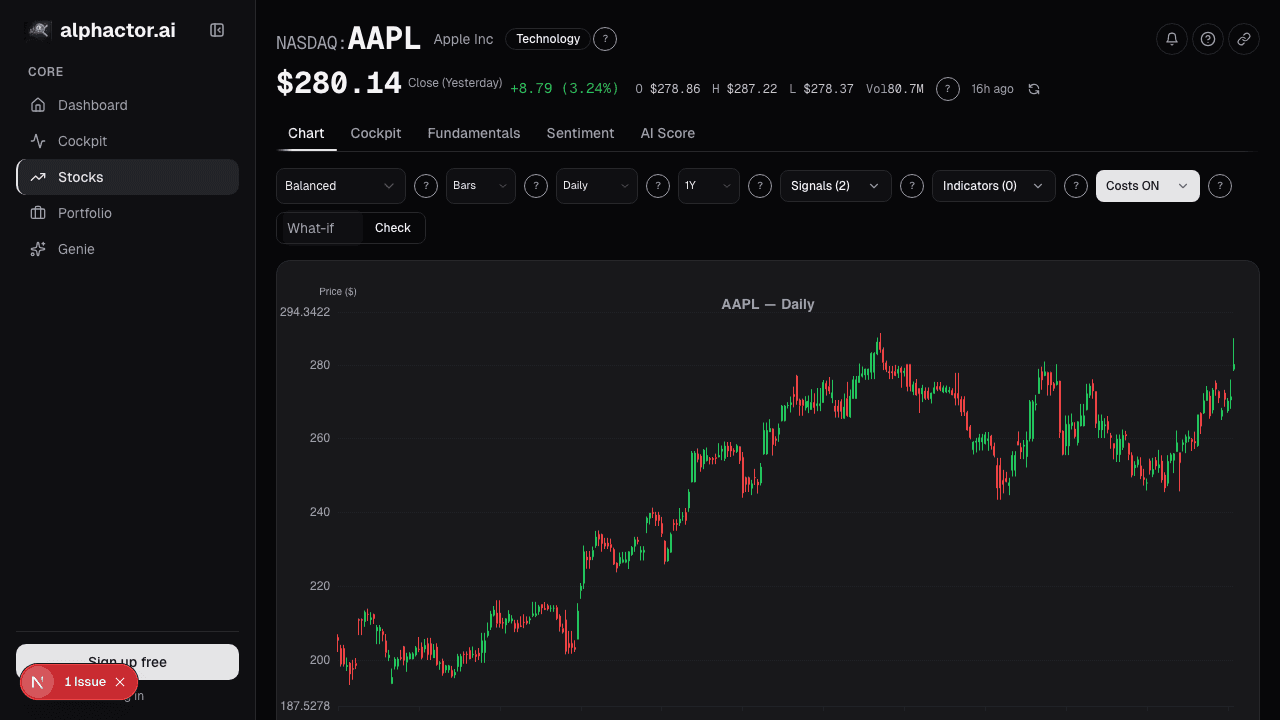
Practical tip: Set your trailing stop width based on the stock's actual volatility, not a round number that feels right. A 15% trail is too tight for Tesla and too wide for Procter & Gamble. Use the stock's average true range (ATR) as a guide: a trail of 2-3x the 14-day ATR gives the position room to breathe without surrendering too much profit.
Volatility-Based Stops
Volatility-based stops adjust automatically to the stock's current behavior. The most common implementation uses a multiple of the Average True Range (ATR). If a stock's 14-day ATR is $3 and you use a 2.5x multiplier, your stop sits $7.50 below the current price or recent high.
When they work: Almost everywhere, which is why professional desks favor them. A volatility-based stop is tight when the stock is calm and wide when the stock is jumpy. This means you get stopped out less often during volatile periods (when false signals are most common) and more quickly during quiet periods (when a sudden move is more likely to be real). It adapts to the market instead of fighting it.
When they fail: Volatility regime changes. If a stock has been calm for months and suddenly doubles its ATR on a news event, a volatility-based stop calculated on the old regime will be too tight. The fix is to use a lookback period long enough to capture at least one volatile episode, or to recalculate the stop when volatility shifts materially.
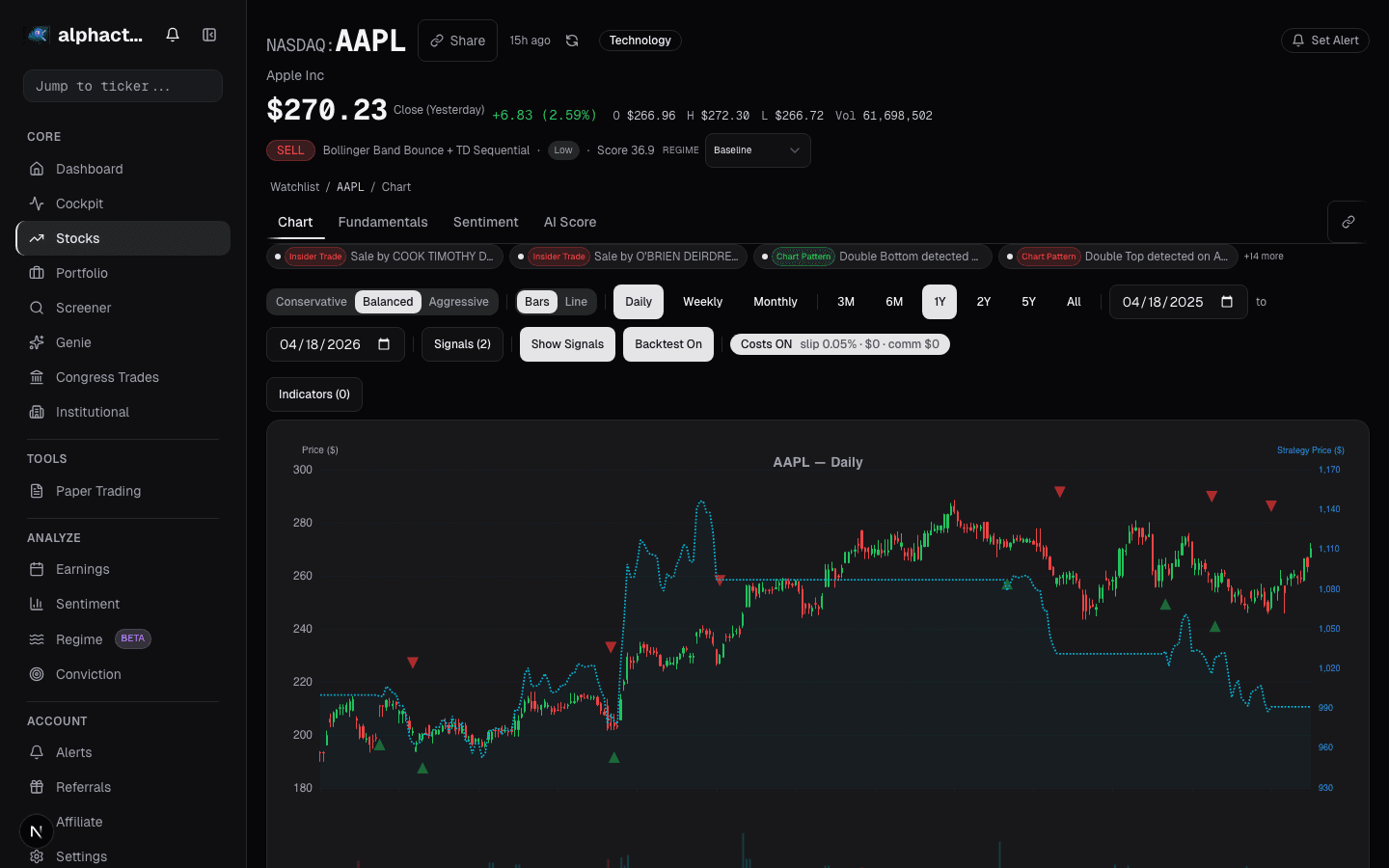
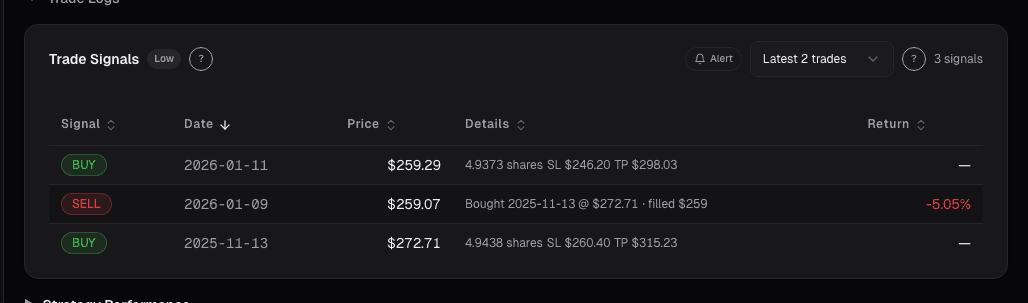
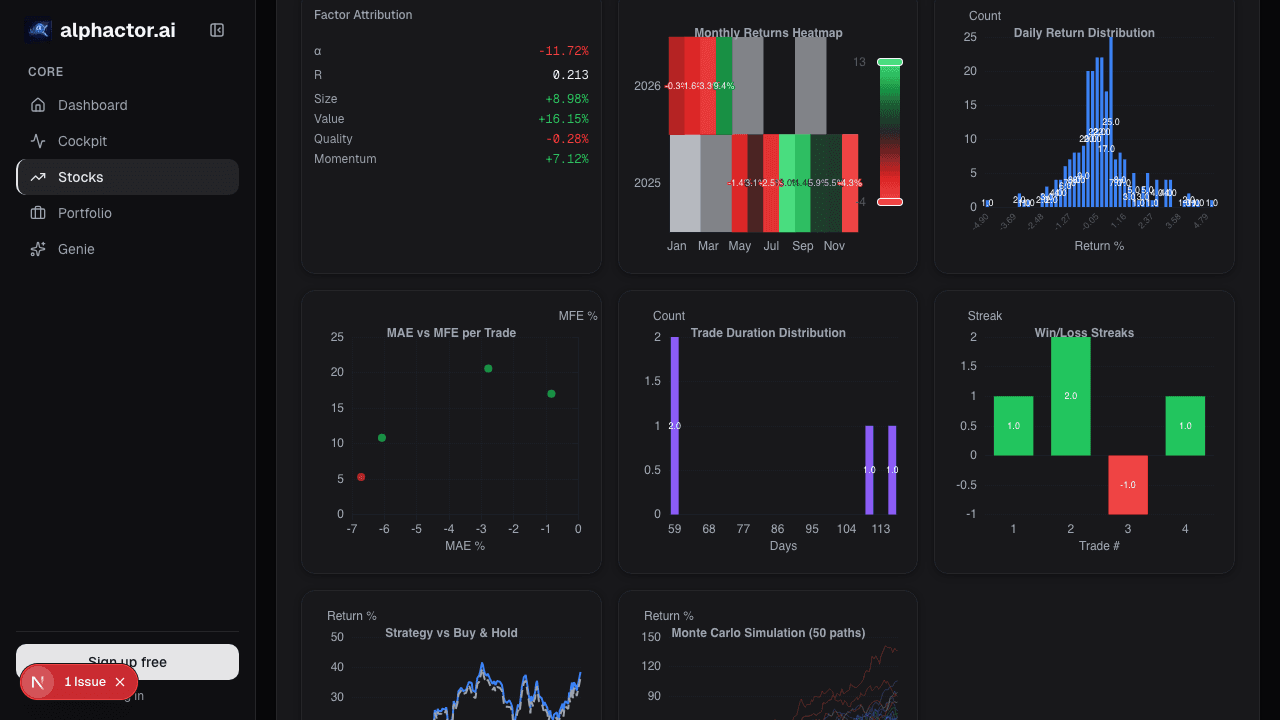
Implementation note: You can use Alphactor backtesting to see how different stop strategies would have performed during historical volatility spikes. Before committing to a specific multiplier, run it against periods like March 2020 or the 2022 rate shock to see where your stops would have triggered.
The Hybrid Approach
Most professional risk managers do not pick one type exclusively. They layer them.
A reasonable framework: use a volatility-based trailing stop as your primary exit mechanism. Set it at 2-3x ATR trailing from the highest close. Then add a hard floor, a fixed price below which the position is closed regardless of the trailing calculation. The trailing stop handles normal market conditions. The hard floor handles the scenario where a stock gaps down through your trailing stop on a binary event.
Choosing Your Stop
Match the stop to the strategy. Fixed stops for thesis-driven trades with clear invalidation points. Trailing stops for momentum and trend plays. Volatility-based stops as a default when you want the market to tell you what "normal" looks like. Alphactor charts overlay ATR bands directly on the price chart so you can visualize where a volatility-based stop would sit. And regardless of type, write the stop down before you enter the trade. A stop loss decided in advance is risk management. A stop loss decided while the stock is falling is panic.
See it in the app
Live dashboard views that match this post. Each tile deep-links to the exact card.
Stocks mentioned
Related reading
In a Crisis, All Correlations Go to One
Diversification fails exactly when you need it most. Here is why correlations spike during crises and how to build portfolios that survive it.
Portfolio Earnings: Calendar, Exposure
Earnings risk is about the whole book into the week, not each position. When 40% of NAV reports in one week, and 60% of that is in a single sector, you're…
Factor Exposure
Factor exposures are bets whether or not you chose them. Decomposition surfaces unintentional tilts before a rotation exposes them as underperformance.
FX Exposure: The Currency Risk Hiding in Your USD Portfolio
You bought US stocks in dollars, so you have no FX risk, right? Wrong. US large-cap multinationals earn 40-60% of revenue abroad.
Risk Management for Retail Portfolios
Practical position sizing, stop-loss strategies, correlation awareness, and drawdown limits for retail investors managing their own money.
Ready to try alphactor.ai?
Validate your trading strategies with statistical credibility testing. Start free.
Get Started Free