Part of: Risk Management
Survivorship Bias: The Invisible Flaw in Your Stock Screener
Survivorship bias silently inflates backtest returns and warps stock screener results. Here is how it works and what to do about it.
 Marcus Chen4 min read
The Stocks You Never See
Open any stock screener. Search for companies that have compounded earnings at 15%+ annually for the past decade. You will get a list of impressive names. Run a backtest: buying these stocks ten years ago and holding would have generated outstanding returns. You conclude the strategy works.
It does not. Or rather, it does not work as well as your backtest suggests, because your screener has a fundamental flaw: it only shows you the survivors.
For every company that compounded earnings at 15% for a decade and is still publicly traded, there are companies that compounded at 15% for seven years and then went bankrupt. Companies that were acquired at depressed prices. Companies that were delisted. Your screener does not show you these stocks because they no longer exist. You are studying the winners and concluding that winning is easy.
The Scale of the Problem
Survivorship bias is not a minor statistical curiosity. It materially distorts returns.
A widely cited study by Elton, Gruber, and Blake found that survivorship bias inflated mutual fund returns by roughly 1.5% per year. In equities, the effect can be larger. Research from the University of Chicago's CRSP database shows that approximately 40% of all stocks that have ever been listed on major US exchanges have experienced a permanent decline of 70% or more from their peak. Many of these stocks eventually delisted entirely. None of them show up in a backward-looking screener.
From 2000 to 2023, the Russell 3000 index had cumulative member turnover of more than 100%. More stocks left the index (through bankruptcy, delisting, or acquisition) than remained. If you backtest a strategy using only the stocks currently in the Russell 3000, you are testing on a completely different universe than what actually existed during the backtest period.
How It Warps Your Analysis
Survivorship bias corrupts analysis in several specific ways:
Inflated hit rates. If you screen for stocks that met certain criteria ten years ago and measure their returns, you are only measuring the ones that survived. The ones that met the same criteria and then failed are excluded. Your strategy's apparent hit rate is artificially high.
Understated risk. The worst-performing stocks in any strategy tend to be the ones that delist. By excluding them, your backtest understates maximum drawdown, understates loss frequency, and overstates risk-adjusted returns. You think your worst-case scenario is a 30% loss. In reality, some of those positions went to zero, you just cannot see them anymore.
False factor validation. If you discover that companies with a specific characteristic (say, high R&D spending) outperformed over the past 20 years, you might conclude that high R&D spending is a positive factor. But if the high R&D spenders that failed and delisted are excluded from your analysis, you are observing selection bias, not a genuine factor.
Misleading sector analysis. "Tech stocks have returned 14% annually over the past 15 years." That number only includes the tech stocks that survived. It excludes the hundreds of tech companies from 2008 that no longer exist. The actual return of investing in all tech stocks, including the failures, is significantly lower.
The Enron Test
In December 2000, Enron was the seventh-largest company in America by revenue. It appeared on every large-cap screen. It met most quality criteria: revenue growth, market leadership, analyst coverage. If you were running a backtest that started in 1995 using today's stock universe, Enron would not appear anywhere in your data. You would never know your strategy would have held a position that went from $90 to $0.26 in twelve months.
The same applies to Lehman Brothers, Washington Mutual, WorldCom, Bear Stearns, and hundreds of less famous names. These were not penny stocks. They were blue chips that screened well on every conventional metric until they did not.
What You Can Do About It
Use survivorship-bias-free databases. CRSP, Compustat's Point-in-Time database, and certain commercial providers include delisted securities with their full price history. If your data source only includes currently traded stocks, your backtests are unreliable. Alphactor backtesting accounts for delisted securities in its historical data, so the results you see reflect what would have actually happened, not a curated version.

Add delisting returns to your model. When a stock delists, it does not disappear at its last traded price. It disappears at a delisting return, which is often a significant loss. Academic research suggests using a -30% delisting return for stocks removed from exchanges for performance-related reasons. This single adjustment can reduce backtest returns by 2-4% annually.
Be skeptical of impressive backtests. Any backtest showing consistent 20%+ annual returns should be interrogated for survivorship bias before anything else. Ask: does this data include companies that went bankrupt during the test period? If the answer is no or unclear, the results are unreliable.
Forward-test strategies on full universes. The best cure for survivorship bias is real-time tracking. Run your screener today using the universe scanner, record every stock it surfaces, and measure actual results going forward. Twelve months of real forward-testing is worth more than twenty years of biased backtesting.
The Takeaway
Survivorship bias does not just make strategies look slightly better. It makes bad strategies look good and mediocre strategies look great. If you are making allocation decisions based on backtests that only include stocks that still exist, you are navigating with a map that has all the cliffs erased. The terrain is more dangerous than it appears.
See it in the app
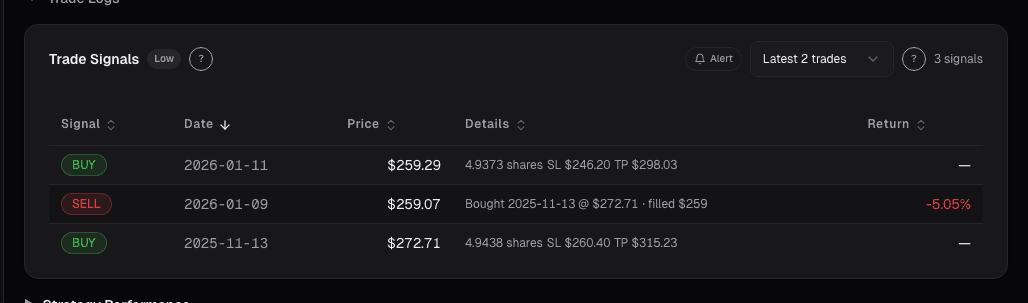
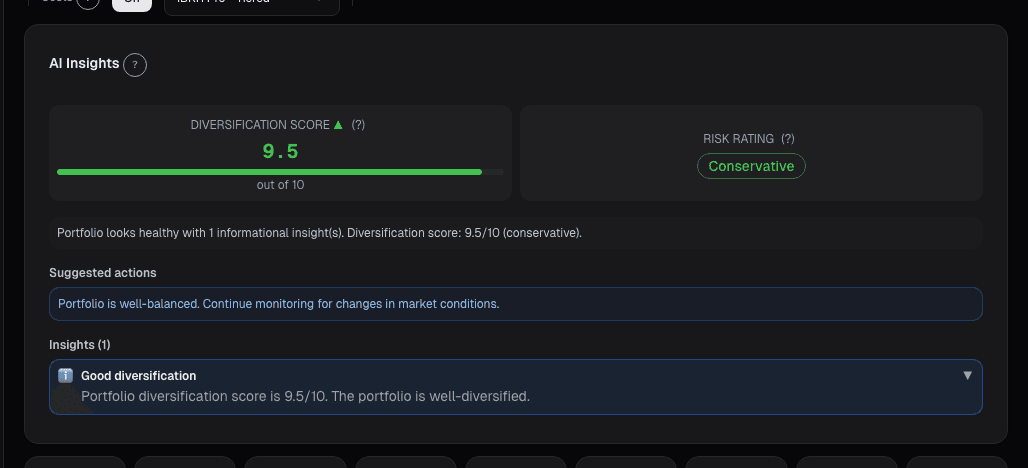
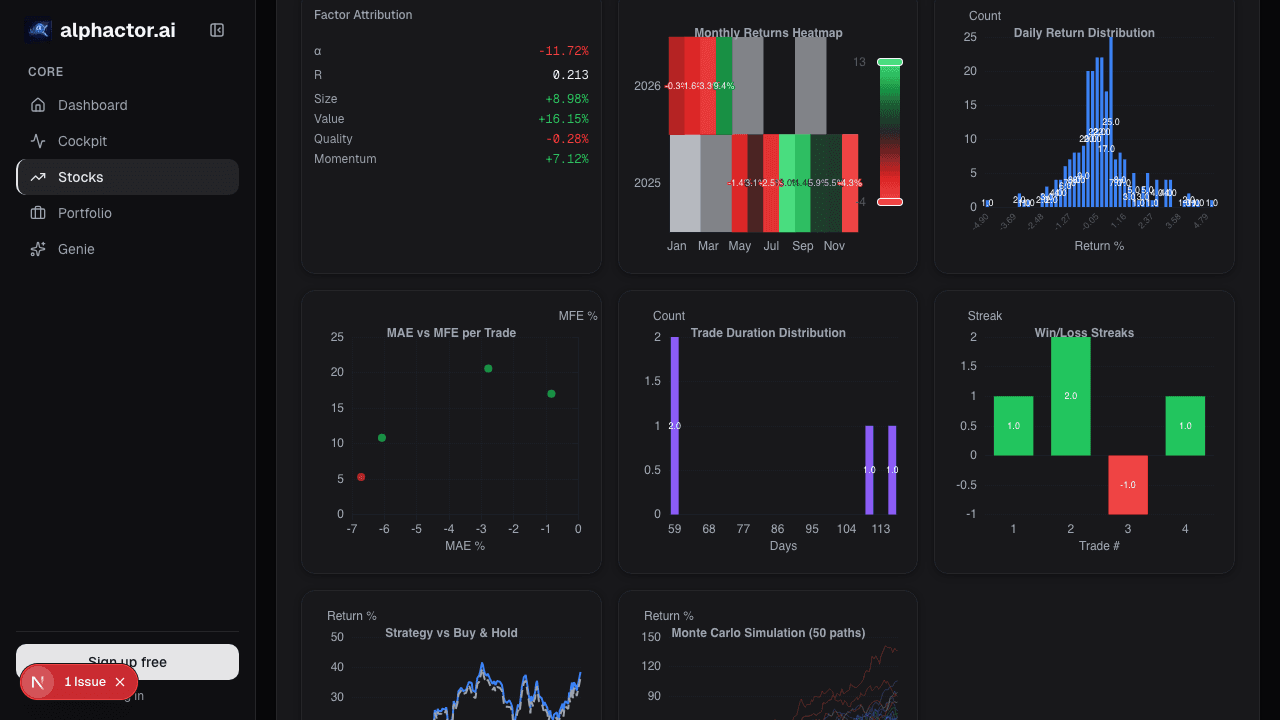
Live dashboard views that match this post. Each tile deep-links to the exact card.
Stocks mentioned
Related reading
Portfolio Earnings: Calendar, Exposure
Earnings risk is about the whole book into the week, not each position. When 40% of NAV reports in one week, and 60% of that is in a single sector, you're…
Factor Exposure
Factor exposures are bets whether or not you chose them. Decomposition surfaces unintentional tilts before a rotation exposes them as underperformance.
FX Exposure: The Currency Risk Hiding in Your USD Portfolio
You bought US stocks in dollars, so you have no FX risk, right? Wrong. US large-cap multinationals earn 40-60% of revenue abroad.
Regime-Aware Strategy Selection
Markets cycle through trends, ranges, and shocks. Learn how regime detection drives which strategy runs, and why a mixture of experts beats a single static…
The 7 Optimization Traps That Kill Backtested Strategies
Seven specific ways traders overfit their backtests, with examples, detection methods, and the statistical tools that separate real edges from noise.
Walk-Forward Testing: The Only Backtest That Matters
Why walk-forward testing is the gold standard for strategy validation, how it works mechanically, and what the efficiency ratio tells you about real versus…
Ready to try alphactor.ai?
Validate your trading strategies with statistical credibility testing. Start free.
Get Started Free